

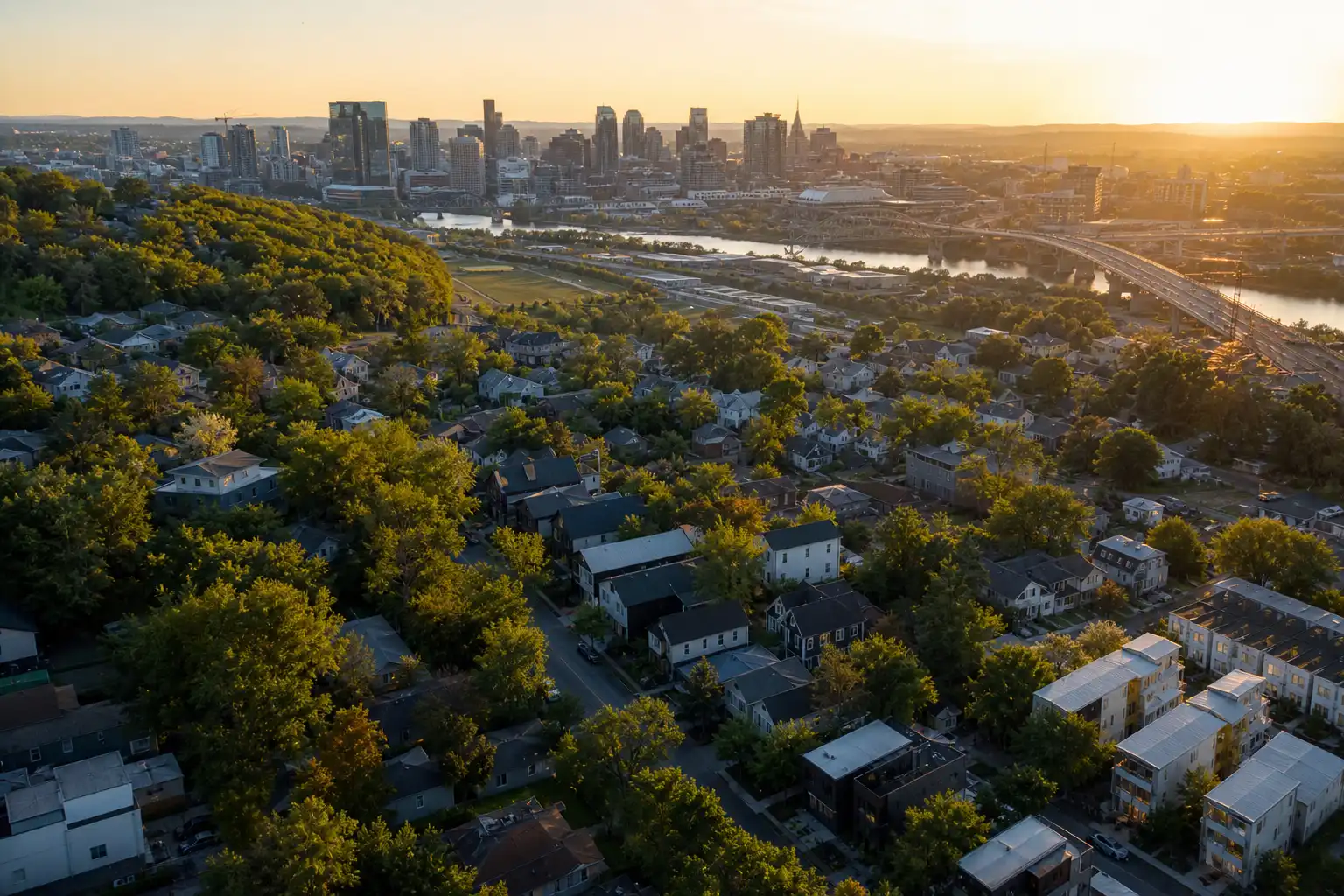
Oracle’s 70-acre East Bank riverfront campus is in active demolition and early infrastructure work as of 2026, with full buildout expected around 2031. Buyers in East Nashville and Germantown are already factoring this long-horizon project into home values, commute expectations, and new construction decisions, even though the biggest changes are still years away.
How is Oracle’s East Bank campus affecting Nashville home values and buyer decisions in 2026?
Oracle’s 70-acre East Bank riverfront campus is in active demolition and early infrastructure construction as of September 2026, with the full buildout expected around 2031. Buyers in East Nashville and Germantown are already pricing in the long-term upside, and the near-term disruption, even though the project’s biggest impacts on home values, commute patterns, and new construction are still several years away.
Key Takeaways
- Oracle submitted permits in January 2026 to demolish more than 515,000 square feet of industrial buildings on its East Bank site, and active demolition and underground utility work were confirmed underway by April 2026.
- Metro Nashville’s “Early Works” infrastructure phase, covering utility relocations, power-line underground work, and site preparation, was approved in March 2026 and is anticipated to be completed in spring 2027.
- The full Oracle campus buildout is expected around 2031, meaning buyers today are making a multi-year bet, not a near-term windfall play.
- Recent local market data shows a median sale price of $700,000 in East Nashville, with only 16 active listings and a median of 46 days on market, inventory remains tight despite broader Nashville inventory gains.
- Germantown’s median sale price reached $729,000 in the three months ending April 2026, up 20.5% year-over-year, according to Redfin, making it one of the fastest-appreciating urban neighborhoods in the city.
What is actually happening on Oracle’s East Bank site right now?
More than most buyers realize, the East Bank is already a construction zone, and has been since early 2026.
In January 2026, Oracle moved to clear its Nashville land for a $4 billion campus, submitting permits to demolish more than 515,000 square feet of industrial buildings across its East Bank assemblage. Metro rules required demolition to start within 30 days of permit issuance and finish within 60 days, so Oracle had to move fast, and it did. By April 2026, The Tennessean confirmed that warehouse demolition had commenced and underground utility work had started in portions of the project area.
This isn’t just Oracle acting alone. Metro Nashville has its own infrastructure agenda running in parallel. In March 2026, Metro Water Services and the Nashville Department of Transportation and Multimodal Infrastructure approved an “Early Works” package for the East Bank, covering demolition of existing structures, relocation of NES overhead power lines, and preparation for underground utilities to serve the surrounding districts. That phase is anticipated to be completed in spring 2027. Per the Q4 2025 East Bank Quarterly Report, utility relocation along Cowan Street and Marine Drive was already scheduled for early 2026.
The big picture: Oracle controls more than 70 acres in the River North district along the East Bank, where it plans a multi-billion-dollar headquarters campus and associated riverfront park, with full completion expected around 2031. As of April 2026, Oracle confirmed to Nashville officials that establishing its global headquarters here remains the goal, even as the broader tech sector has navigated layoffs.
So when buyers ask me what’s happening over there, the honest answer is: the ground is being cleared, the utilities are being moved, and the foundation for a decade-long transformation is being laid. You can see it from the bridges. What you can’t see yet is the finished campus, the riverfront park, or the new street grid, those are still years away.
How should buyers think about East Nashville and Germantown right now?
The Oracle campus is a long-horizon catalyst, not a short-term price trigger. Here’s how I frame it for buyers who are seriously weighing these neighborhoods.
East Nashville: tight inventory, higher prices, fewer closings
Recent local market data puts the median sale price in East Nashville at $700,000, with just 16 active listings, 5 new listings in the past 30 days, and a median of 46 days on market. Those are area-level figures, what any individual home is worth depends on its street, condition, build year, and timing, but the directional story is clear: this is a supply-constrained market.
That constraint is real even as the broader Nashville metro has added inventory. According to Capital Analytics Associates, active residential inventory across Greater Nashville reached 11,406 units at the start of 2026, a 13% year-over-year increase and the most available since 2014. But that supply expansion hasn’t reached the urban core. East Nashville, Germantown, 12 South, and The Gulch remain inventory-constrained for well-located, move-in-ready product.
I’ve also noticed that some East Nashville sellers are in a “wait and see” posture, holding off on listing until they have a clearer read on how the East Bank buildout affects their street. That’s part of why new listings are trickling in rather than flooding the market. For buyers, that means competition for the right home doesn’t disappear just because Oracle’s campus is still five years from completion.
If you’re thinking about how to position an offer in this environment, the post on pricing your Nashville home to sell in 2026 gives useful context on how sellers are calibrating their expectations right now.
Germantown: premium pricing, rapid appreciation, a different product mix
Germantown sits on the north side of downtown along the riverfront, with walkable access to downtown, stadium amenities, and the expanding riverfront park system. Buyers often view it as the most direct “front row seat” to the East Bank transformation, and the pricing reflects that.
According to Redfin’s data for the three months ending April 2026, Germantown’s median sale price was $729,000, up 20.5% year-over-year, with a median price per square foot around $543. Days on market averaged 83, slower than the prior year’s 50 days, which tells me buyers are being more deliberate, but prices aren’t softening.
The product mix matters here. Entry-level condo and rowhouse product in Germantown starts in the low-to-mid $400,000s to $600,000s range. Single-family homes and luxury attached townhomes cluster well above $1 million, often in the $1.5M-plus bracket, reflecting both historic inventory scarcity and proximity to downtown. Riverfront condos with river views, walkability to Oracle-adjacent parks, and amenity packages, parking, pools, co-working spaces, command a meaningful premium over standard East Nashville townhomes on a per-square-foot basis.
For comparison, the Nashville citywide median home price was $539,945 as of June 2026, down approximately 1.6% year-over-year. Germantown’s 20.5% year-over-year gain in the same window tells you exactly how much the urban riverfront premium has diverged from the broader market.
The commute question: what changes and when
Commutes from East Nashville and Germantown to downtown today still run primarily through existing bridges and arterials, Woodland Street Bridge, Jefferson Street, James Robertson Parkway. Oracle-related infrastructure work is beginning to affect segments around Cowan Street and Marine Drive, creating temporary detours and construction traffic.
Here’s the honest framing I give buyers: the Early Works phase running through spring 2027 is about site preparation and utilities, not new bridges or transit lines. The commute improvements buyers are imagining, new street grids, park-integrated bike and pedestrian paths, better East Nashville-to-downtown access, are tied to later phases of the East Bank buildout, not the 2026-2027 window. Anyone buying near the East Bank today should plan on construction noise, truck traffic, and changing access routes through at least 2031.
That’s not a reason to walk away. It’s a reason to go in with eyes open. If you’re relocating and want a broader picture of what Nashville’s urban core is like to live in day-to-day, the post on what to expect when you relocate to Nashville is worth reading before you start touring.
| Market Metric | East Nashville (Sept 2026) | Germantown (3 mo. ending Apr 2026) | Nashville Citywide (June 2026) |
|---|---|---|---|
| Median Sale Price | $700,000 | $729,000 | $539,945 |
| Year-over-Year Price Change | Not available | +20.5% | -1.6% |
| Median Days on Market | 46 | 83 | Not available |
| Active Listings | 16 | Not available | 11,406 (Greater Nashville, start of 2026) |
Sources: Recent local market data (East Nashville); Redfin (Germantown); Follow Up Ace and Capital Analytics Associates (Nashville citywide and Greater Nashville). East Nashville area-level figures reflect trailing ~90 days of aggregated public listing data; individual home values vary by condition, street, build year, and timing.
Should you buy near the East Bank now, or wait?
This is the question I get most often, and there’s no universal answer, but I can tell you how I think through it with buyers who are seriously considering this corridor.
The case for moving now is real. Inventory in East Nashville and Germantown is genuinely thin. With only 16 active listings in East Nashville and Germantown posting a 20.5% year-over-year price gain, waiting for the Oracle campus to be “closer to done” may simply mean paying more. Long-term, Oracle’s global headquarters commitment to Nashville reinforces what I’ve always believed about this city: real estate here is a wealth-building play, not just a place to live. The East Bank amplifies that thesis for anyone with a five-to-ten-year horizon.
The case for caution is also real. Construction disruption is not a minor inconvenience, it’s a multi-year reality. If you’re buying a riverfront condo or a home on a street adjacent to the Oracle site, think carefully about unit orientation (river-facing vs. inward-facing), soundproofing, and your personal tolerance for construction traffic during the day. The Early Works phase alone runs through spring 2027. Full campus completion is expected around 2031. That’s a long runway of active construction in your backyard.
Your specific calculus depends on your timeline, your price point, and exactly which street or building you’re considering. That’s the kind of analysis I walk buyers through before we even make an offer, because the right answer for someone buying a Germantown condo at $550,000 is different from the right answer for someone looking at a $1.5M townhome two blocks from the Oracle site.
Mortgage rates add another layer. As of July 2026, 30-year fixed rates were estimated around 6.43% and 15-year fixed rates around 5.79% for Nashville buyers. Those rates shape what you can afford and how aggressively you can compete. Verify your own numbers with your lender, rates move, and your qualifying rate matters more than any market average.
Frequently Asked Questions
Is Oracle really still building that East Bank headquarters, and what’s actually happening on the riverfront right now?
Yes, Oracle’s East Bank campus is an active construction project as of September 2026, not a stalled announcement. Demolition of existing industrial warehouses commenced in early 2026, and underground utility work is underway on portions of the site, according to The Tennessean’s April 2026 coverage. As of April 2026, Oracle confirmed to Nashville officials it is still pursuing its global headquarters here. The full campus is expected to be completed around 2031, so the project is real and moving, but it’s in early-stage demolition and infrastructure work, not vertical construction.
How will Oracle’s East Bank campus affect home values in East Nashville and Germantown over the next five to ten years?
The directional expectation among local buyers and investors is that Oracle’s campus will support long-term demand for walkable, higher-density housing near the riverfront, but quantifying that impact today is speculative. What’s measurable now is that Germantown’s median sale price was already up 20.5% year-over-year as of the three months ending April 2026, per Redfin, and East Nashville’s median sits at $700,000 in a market with only 16 active listings. Whether Oracle accelerates appreciation further depends on how quickly jobs materialize, how the public-realm improvements are phased, and what the broader rate environment looks like. Your specific home’s trajectory depends on its street, condition, and timing, a local market analysis is the only honest way to model it.
Should I pay a premium today to be near the East Bank if the Oracle project won’t be finished until around 2031?
Paying a premium for proximity to a project with a 2031 completion horizon is a long-term bet, not a short-term arbitrage. The premium may already be priced into Germantown’s 20.5% year-over-year appreciation, which means you’re not getting in “early” in the way buyers who moved here five years ago did. That said, inventory in both East Nashville and Germantown is thin, and waiting for more certainty about Oracle’s timeline may simply mean competing at a higher price point later. The honest answer is that the right decision depends on your financial position, your timeline, and exactly which property you’re considering, bring those specifics to a consultation so we can run the numbers together.
Are East Nashville and Germantown still competitive for buyers, or has inventory loosened up?
Both neighborhoods remain inventory-constrained despite a broader Nashville inventory expansion. Greater Nashville active inventory reached 11,406 units at the start of 2026, a 13-year high according to Capital Analytics Associates, but the urban core hasn’t seen that relief. East Nashville has just 16 active listings as of September 2026, and Germantown’s days on market averaged 83 in spring 2026, slower than the prior year but at a significantly higher median price. Competition for well-located, move-in-ready product in both neighborhoods remains real.
Will Oracle’s new campus change commute times from East Nashville or Germantown to downtown?
Not in the near term. The current “Early Works” infrastructure phase, running through spring 2027, focuses on utility relocations and site preparation, not new bridges, transit lines, or road networks that would meaningfully shorten commutes. Major commute improvements tied to the East Bank’s new street grid and park-integrated pedestrian and bike paths are later-phase items, not 2026-2027 deliverables. Buyers with a five-to-ten-year horizon may see real commute benefits as the campus and surrounding public realm are built out, but anyone buying today should plan around existing bridge and arterial routes, plus construction-related detours near Cowan Street and Marine Drive through at least 2027.
The Oracle East Bank campus is the most consequential development project in Nashville’s urban core in a generation, and the market is already starting to reflect it, even though the campus itself is still years from completion. If you’re weighing East Nashville, Germantown, or a riverfront condo as a long-term hold, the window to get ahead of that story is now, not in 2031.
I work with buyers who want to think about real estate as a long-term wealth-building move, not just a transaction, and the East Bank corridor is exactly the kind of opportunity that rewards that mindset. If you want to talk through what a purchase near the Oracle campus would actually look like for your situation, schedule a consultation with me here.
The Lanagan Group is a real estate team affiliated with Compass RE, a licensed real estate broker, and abides by all applicable Equal Housing Opportunity laws. Ethan Lanagan is a REALTOR® licensed in TN and CA, regulated by the Tennessee Real Estate Commission (TREC). This article is general market information only and does not constitute legal, tax, or financial advice, confirm your own numbers with your title company, tax advisor, or lender.