


The short answer: Yes. A California rental or investment property can be exchanged for Nashville or Franklin investment property under Section 1031, because all U.S. real property is like-kind. You have 45 days to identify replacement property and 180 days to close, and if your California sale closed after October 17, 2026, you will likely need a tax-return extension to get the full 180 days. California will still track the deferred gain through an annual Form 3840 filing.
Can I do a 1031 exchange from California into Nashville?
You can. The IRS says real property is generally like-kind to other real property “whether improved or unimproved,” and the only geographic line it draws is between U.S. and foreign property. That means an Orange County fourplex can become three single-family rentals in Davidson County, a Franklin townhome portfolio, or a small multifamily building in East Nashville, as long as both sides are held for investment or business use. I hold real estate licenses in both Tennessee and California, and this is one of the most common conversations I have with California owners right now: how to move equity they’ve built over a decade into a market with lower property taxes and room to grow, without handing a large share of it to the IRS and the Franchise Tax Board on the way out.
Key Takeaways
- 45 and 180 days. You must identify replacement property in writing within 45 days and close within 180 days, or by your tax return due date if that’s earlier (IRS Form 8824 instructions, 2026).
- The October 17 trap. For calendar-year filers, any sale that closed after October 17, 2026 hits the April 15, 2027 due date before day 180. Filing an extension restores the full window (my calculation from Treas. Reg. §1.1031(k)-1(b)).
- The equity math. In my illustration, a $1,480,000 Orange County rental (the C.A.R. September 2026 county median) would owe an estimated $361,280 in federal and California tax if sold outright. A 1031 keeps that $361,280 invested.
- Lower carrying costs. Property tax on a $1.5 million purchase runs an estimated $10,553 a year in Nashville’s Urban Services District and $5,873 in Franklin outside the special school district, versus at least $15,000 on a new California purchase (Metro FY27 budget, Williamson County 2026 rates, CA BOE).
- California keeps a claim. You file FTB Form 3840 every year until the deferred California gain is recognized, and California taxes that gain when you eventually sell in a taxable sale (FTB 3840 instructions).
Why are California investors looking at Middle Tennessee right now?
Two reasons: the money goes further, and right now buyers have room to negotiate. The California Association of REALTORS® reported an Orange County median of $1,480,000 in September 2026, up 5.6% from a year earlier, against a statewide median of $899,720. In Middle Tennessee, the September 2026 median was $450,000 in Davidson County and $950,000 in Williamson County (RealTracs data via Grant Hammond, preliminary, the same series I used in my relocation cost guide). One Orange County sale can turn into two or three Nashville properties.
The second reason is negotiating room. Ten-county inventory reached 14,249 homes in September 2026, up 8.4% from a year earlier, with 5.41 months of supply (RealTracs via Grant Hammond). For an exchange buyer, that matters more than usual. A 45-day identification deadline is much less stressful when sellers are competing for you, and more of them are open to concessions, rate buydowns and flexible closing dates that fit your 180-day clock.
Timing works in your favor right now: many sellers and builders have big incentives to hit their end-of-year sales goals, so a buyer who can commit and close on a clear timeline has real leverage on price, rate buydowns and closing costs. My guide to winning builder incentives covers how to ask for them.
Financing costs are the third piece. Mortgage News Daily’s 30-year fixed index jumped to 7.30% on November 10 after a hot inflation report, up from 7.18% the day before and 6.34% a year earlier. Freddie Mac’s weekly survey, which lags fast moves, showed 7.18% for the week of November 5. The 10-year Treasury yield was 5.01% on November 12 (Trading Economics), a spread of 2.29 points. When borrowing costs that much, keeping your full equity in the deal instead of replacing a third of it with debt is a real advantage.
What are the 1031 exchange deadlines, and what is the year-end trap?
The two deadlines run at the same time, starting the day your California property transfers. Under Treas. Reg. §1.1031(k)-1(b), the identification period ends at midnight on day 45, and the exchange period ends on the earlier of day 180 or the due date of your tax return, including extensions, for the year of the sale.
That “earlier of” clause is what catches people at year-end. If you’re a calendar-year filer and you closed after October 17, 2026, day 180 falls after April 15, 2027. Unless you file an extension, your exchange window ends on April 15, possibly weeks before you expected. A December 1, 2026 sale, for example, has an identification deadline of January 15, 2027 and a day-180 deadline of May 30, 2027, so it needs an extension to use the full period. Ask your CPA about filing the extension early.
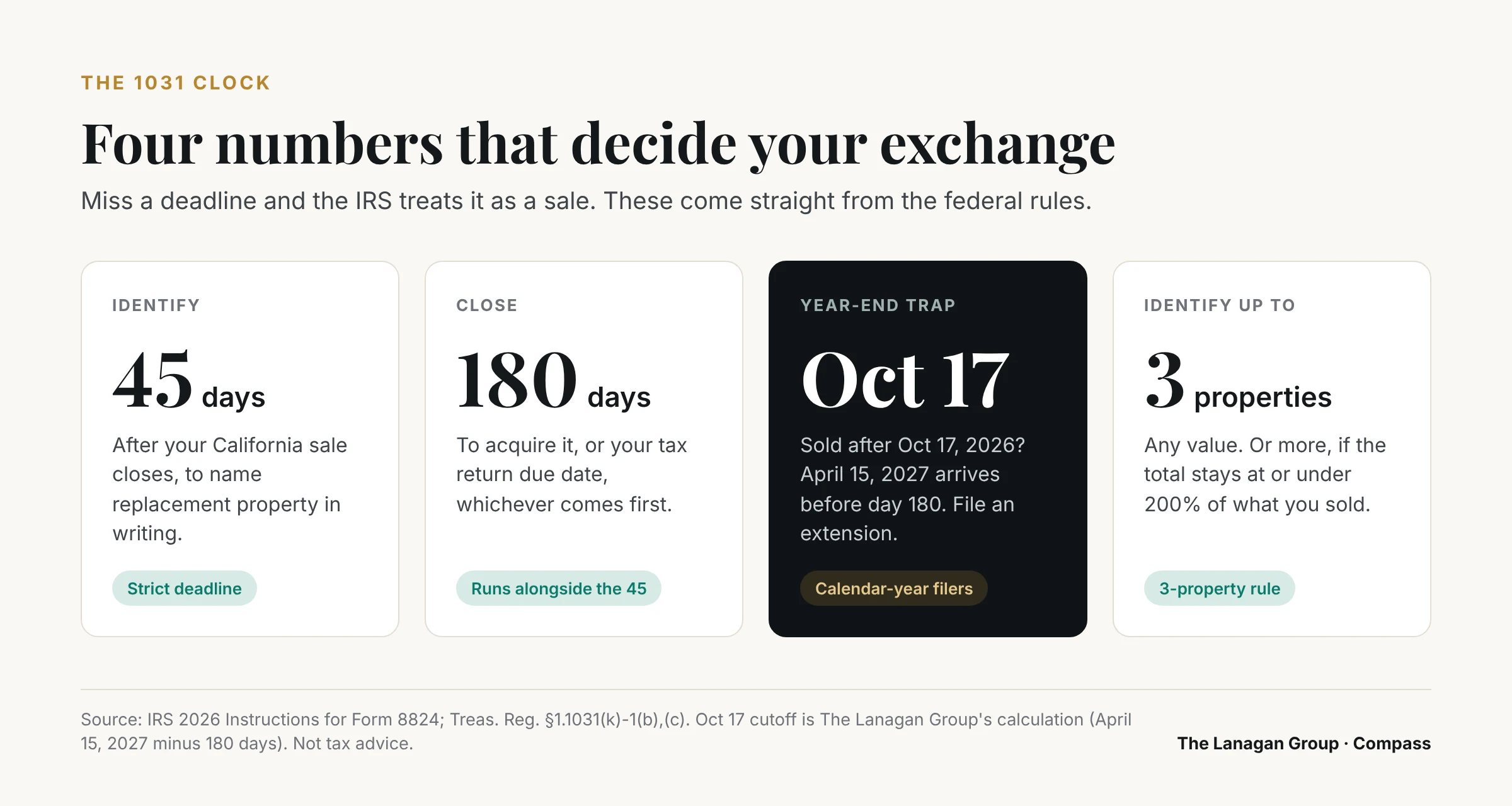
| Rule | What it requires | Source |
|---|---|---|
| Identification period | 45 days after the relinquished property transfers; signed, written, unambiguous description | Treas. Reg. §1.1031(k)-1(b),(c) |
| Exchange period | Earlier of 180 days or the return due date, including extensions | Treas. Reg. §1.1031(k)-1(b) |
| 3-property rule | Up to three properties, regardless of value | Treas. Reg. §1.1031(k)-1(c)(4) |
| 200% rule | Any number of properties if total value is no more than 200% of what you sold | Treas. Reg. §1.1031(k)-1(c)(4) |
| Qualified intermediary | Sale funds held by the QI; touching the money turns the exchange into a sale | Treas. Reg. §1.1031(k)-1(f),(g) |
| Reporting | Federal Form 8824; California FTB 3840 each year after | IRS; FTB |
Calendar-year individual filers. The October 17, 2026 cutoff is my calculation (April 15, 2027 minus 180 days). Not tax advice.
How much equity does a 1031 exchange keep working?
In this example, it keeps about a third of your equity from going to taxes: $361,280 of $1,080,000. Here is an illustration I ran in code, not a forecast for any specific owner. Take an Orange County rental that sells at $1,480,000, the C.A.R. September 2026 county median, with a $500,000 adjusted basis, $150,000 of depreciation taken over the years, and a $400,000 loan to pay off. Before selling costs, the gain is $980,000 and the equity is $1,080,000.
Sold outright at the top rates, the estimated tax comes to $361,280: $37,500 on depreciation recapture at the 25% maximum for unrecaptured §1250 gain, $166,000 in federal long-term capital gains tax at 20%, $37,240 of net investment income tax at 3.8%, and $120,540 at California’s 12.3% bracket. That leaves $718,720 to reinvest. Through a 1031, all $1,080,000 goes into Tennessee real estate.
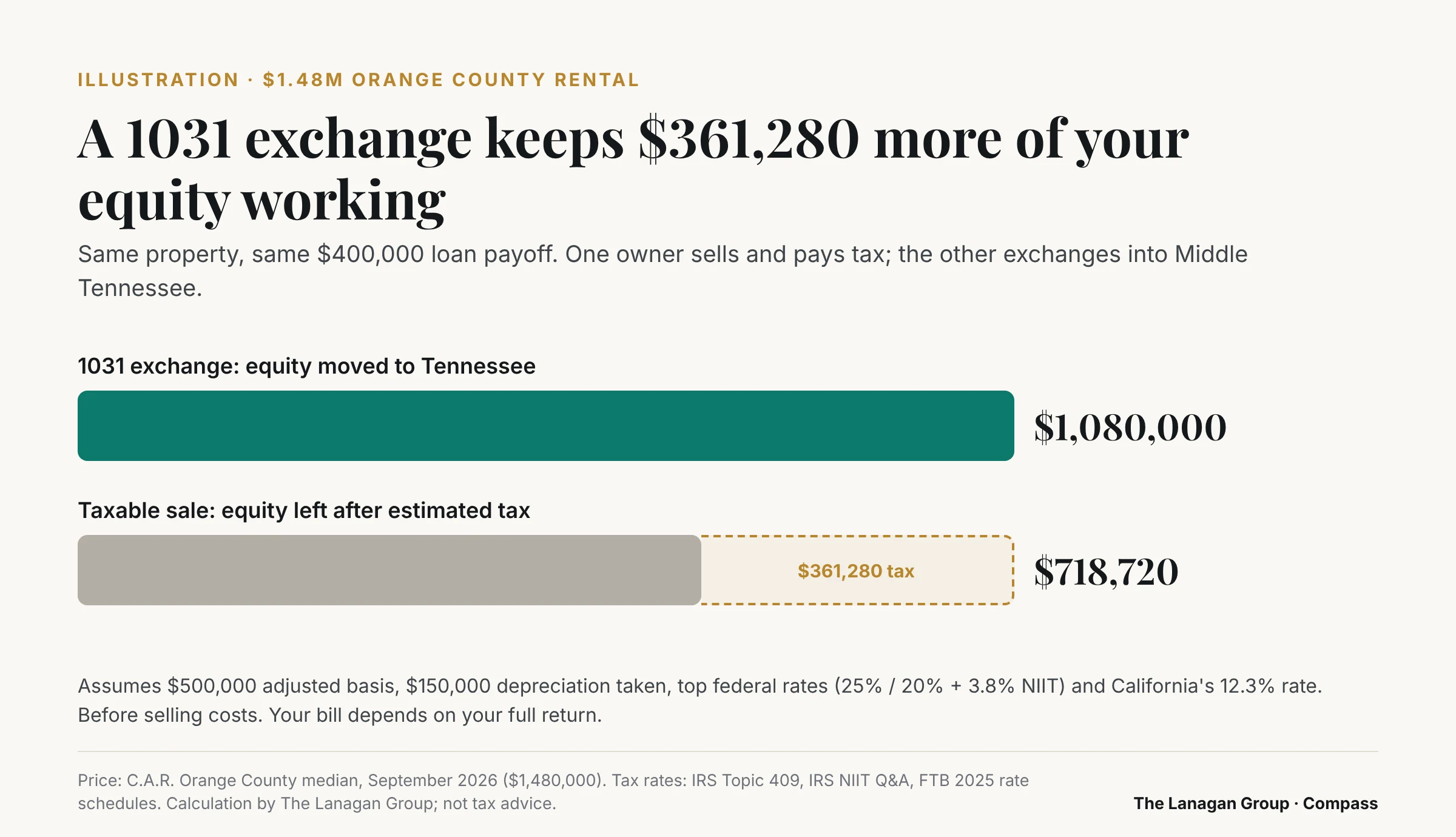
| Line item (illustration) | Amount |
|---|---|
| Sale price (C.A.R. Orange County median, Sept 2026) | $1,480,000 |
| Adjusted basis (assumed) | $500,000 |
| Gain, before selling costs | $980,000 |
| Depreciation recapture at 25% (on $150,000) | $37,500 |
| Federal capital gains at 20% (on $830,000) | $166,000 |
| Net investment income tax at 3.8% | $37,240 |
| California at 12.3% | $120,540 |
| Estimated tax deferred by a 1031 | $361,280 |
| Equity after loan payoff: 1031 vs. taxable sale | $1,080,000 vs. $718,720 |
Sources: IRS Topic 409 (20% and 25% maximum rates); IRS NIIT Q&A (3.8%); FTB 2025 tax rate schedules (12.3%; a 1% Behavioral Health Services Tax applies to taxable income over $1 million). Lower brackets would reduce the tax; selling costs reduce gain and equity. Calculation by The Lanagan Group.
To defer all of the gain, the general rule is to buy property of equal or greater value and reinvest all of the cash. In this example that means at least $1,480,000 of Tennessee property, such as three homes around $500,000 each ($1,500,000 total, which also fits the 3-property rule) with about $420,000 of new financing. Cash you keep, and debt you pay off without replacing it, can be taxable “boot.” Your QI and CPA should run your exact numbers before you list.
How do Tennessee property taxes compare with California?
For a new purchase, Tennessee usually comes out well ahead. California’s Proposition 13 limits the base rate to 1% of assessed value plus voter-approved bonds and caps annual increases at 2%, but the property is reassessed to market value when ownership changes (CA Board of Equalization Pub. 800-10). If you buy a new California rental, you start over at today’s price.
Tennessee taxes residential property on 25% of appraised value (TN Comptroller). Metro Nashville’s Urban Services District rate is $2.814 per $100 of assessed value, unchanged for 2026 in the FY27 budget and the same rate I used in my house hacking guide. That works out to about 0.70% of value. In Williamson County, the 2026 combined rate is $1.566 in Franklin outside the Franklin Special School District, $2.2433 inside it, and $1.49 in Brentwood.
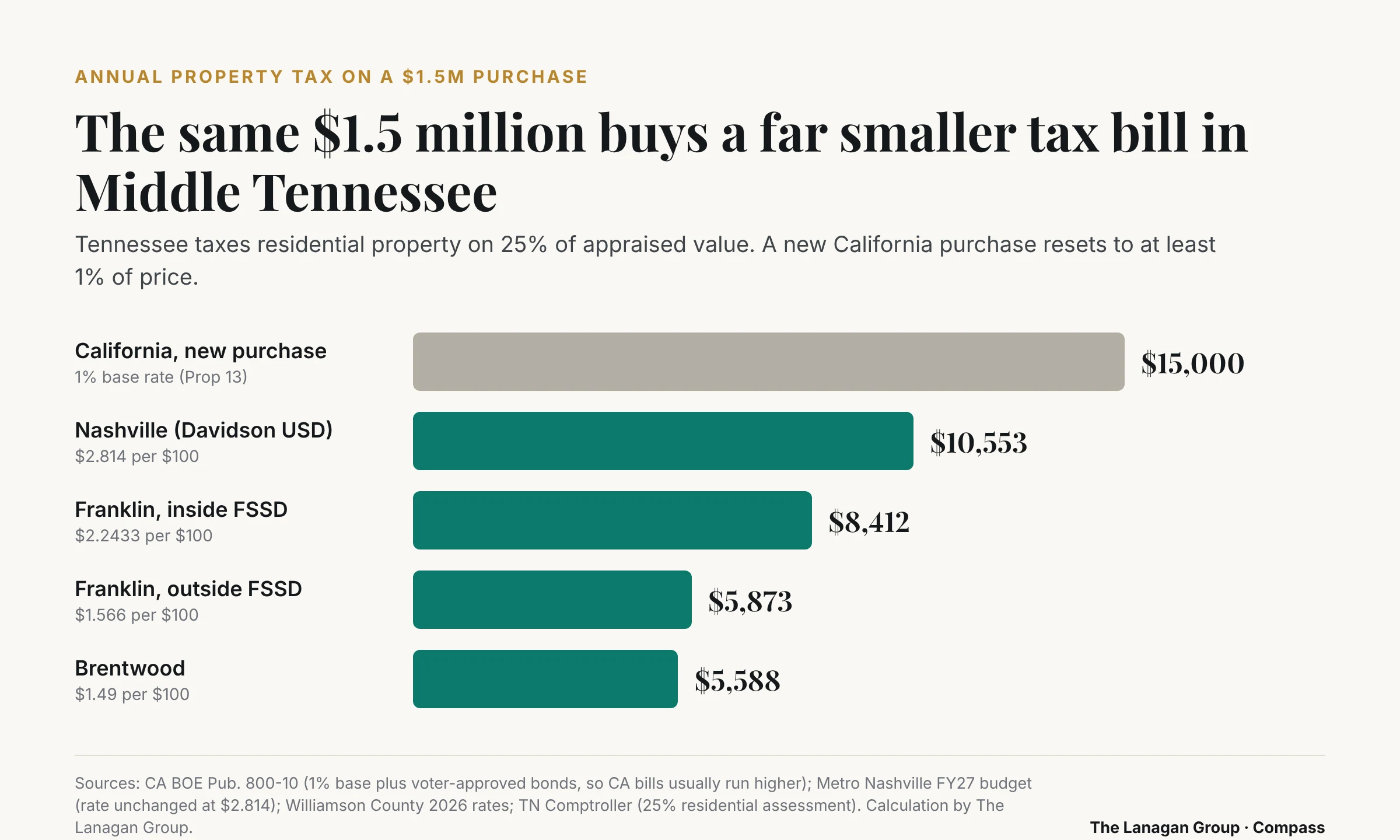
| Location (2026 rate) | Rate per $100 assessed | Effective rate | Tax on $1.5M |
|---|---|---|---|
| California, new purchase | 1% base (plus bonds) | 1.00%+ | $15,000+ |
| Nashville, Davidson USD | $2.814 | 0.70% | $10,553 |
| Franklin, inside FSSD | $2.2433 | 0.56% | $8,412 |
| Franklin, outside FSSD | $1.566 | 0.39% | $5,873 |
| Brentwood | $1.49 | 0.37% | $5,588 |
Sources: CA BOE Pub. 800-10; Metro Nashville FY27 Budget Overview; Williamson County “2026 Property Tax Rates”; TN Comptroller (25% residential assessment). Tennessee rates are final once certified by the State Board of Equalization; confirm with the trustee. Confirm the property’s classification with the assessor.
Transfer taxes are modest on both ends. Tennessee charges $0.37 per $100 of purchase price and $0.115 per $100 of mortgage debt above the first $2,000 (Tenn. Code Ann. §67-4-409; TN Department of Revenue). On a $1,500,000 purchase with $420,000 of financing, that’s $5,550 and $480.70. California’s county documentary transfer tax is $1.10 per $1,000 (R&TC §11911), or $1,628 on a $1,480,000 sale, and some cities add their own. In Tennessee the buyer customarily pays the transfer tax, but who pays is negotiable in the contract.
What does California require when the replacement property is in Tennessee?
California lets the exchange go through but keeps its claim. For taxable years beginning on or after January 1, 2014, the Franchise Tax Board requires FTB Form 3840 when you exchange California property for property outside California, and the filing continues each year “generally until the California sourced deferred gain or loss is recognized” (R&TC §18032). When you eventually sell the Tennessee property in a taxable sale, California taxes the deferred California gain. If you skip the filing, the FTB says it may estimate your income and assess the tax plus penalties and interest.
Withholding is the other California item. On a normal sale, Form 593 requires withholding of 3⅓% of the sales price. In a properly structured deferred exchange, the qualified intermediary withholds only on boot over $1,500. If the exchange fails, the QI must withhold 3⅓% of the sale price, about $49,284 on a $1,480,000 sale (FTB Form 593 instructions, 2026). A clean exchange avoids that.
Tennessee’s side is simple. The state does not tax wages, and the Hall income tax on interest and dividends was repealed for tax years beginning on or after January 1, 2021 (TN Department of Revenue). If you relocate along with your capital, that changes your tax picture going forward. Talk with your CPA about how it applies to you.
How do I run a California-to-Nashville 1031, step by step?
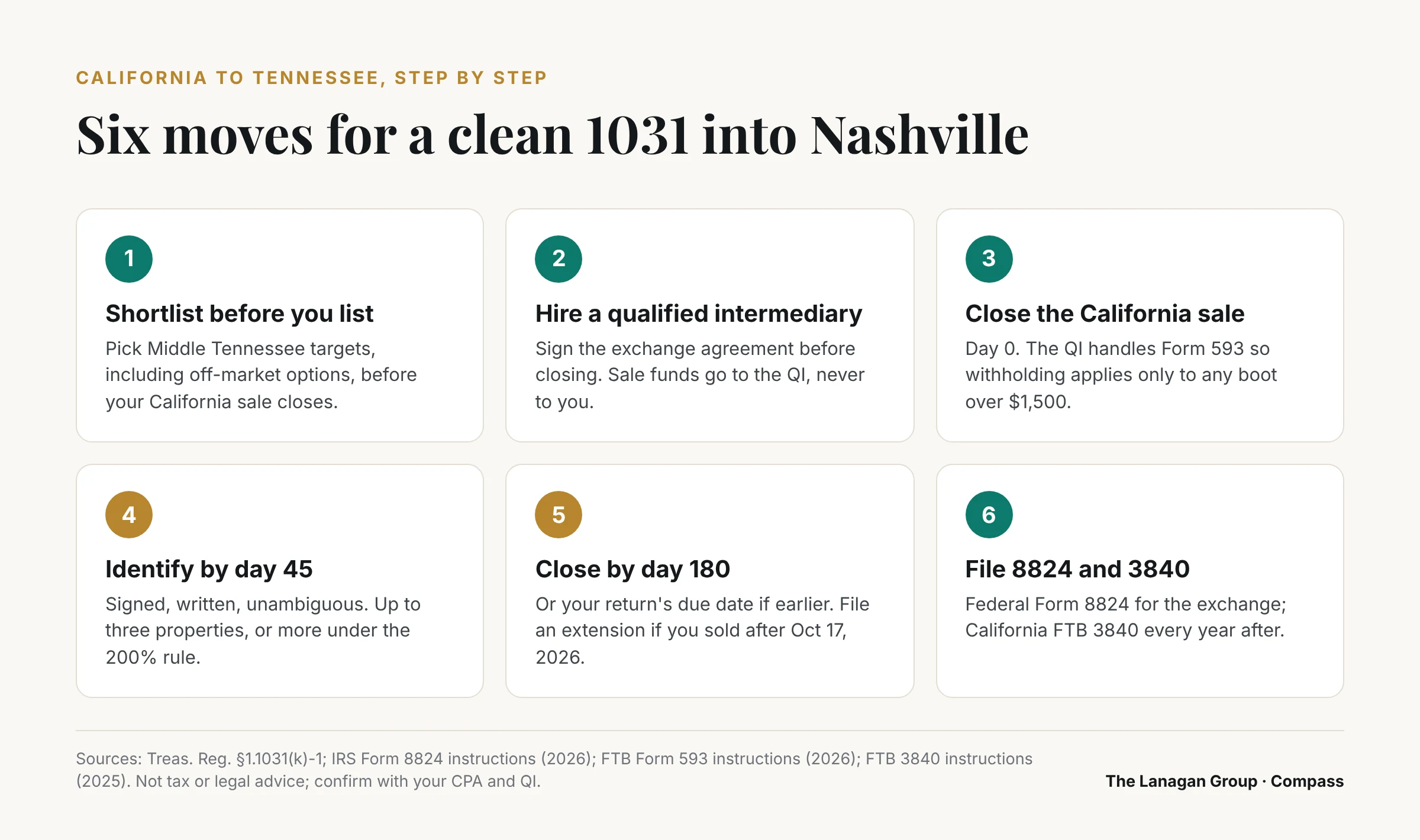
- Shortlist before you list. Forty-five days goes fast from 2,000 miles away. Before your California sale closes, we tour neighborhoods virtually or in person and line up primary and backup targets, including off-market and private exclusive listings, which can give an exchange buyer a real edge.
- Hire a qualified intermediary first. Sign the exchange agreement before your California closing. The QI must hold the funds; if the money is credited to you, the regulations treat it as a sale.
- Close the California sale. Day 0. Coordinate with the QI and escrow on Form 593 so withholding applies only to any boot.
- Identify in writing by day 45. Name up to three properties, or more under the 200% rule, with unambiguous descriptions, and deliver the identification to your QI.
- Get under contract and close by day 180. Make offers that fit your timeline. In today’s market we can often negotiate closing dates, inspections and concessions. File a tax extension if your sale closed after October 17, 2026.
- Report it. File Form 8824 with your federal return and FTB 3840 every year after. Keep your closing statements from both states together.
In my experience, the exchanges that go smoothly are the ones planned before the California listing goes live. That’s where a strong strategy before you make an offer pays off. If you want to see what your equity buys in different submarkets, my Nashville investment strategies guide walks through the property types investors are buying here, and my Franklin market update covers price bands by ZIP code.
Thinking about moving your California equity to Middle Tennessee?
I work both sides of this move. I’m licensed in California with Seven Gables and in Tennessee with Compass, so I can help you plan the California sale and the Tennessee purchase as one timeline, with your QI and CPA in the loop. I don’t see a closing as the end of the relationship. Many of my investor clients come back when they’re ready for the next property. Call or text me at 615-707-0321 or email ethan@thelanagangroup.com to map out your exchange.
See what clients say: Google reviews · Zillow reviews
Frequently asked questions
Can I 1031 exchange a California rental into a Tennessee rental?
Yes. The IRS treats U.S. real property as like-kind to other U.S. real property, so the state doesn’t matter. Both properties must be held for investment or business use, not primarily for resale. California will require an annual FTB 3840 filing afterward.
What happens if I miss the 45-day deadline?
If you don’t identify replacement property in writing by midnight on day 45, the exchange fails and the sale is generally taxable. In a deferred exchange, California also requires the QI to withhold 3⅓% of the sale price when an exchange fails. This is why I recommend lining up targets before your California sale closes.
Why might I need a tax extension for a 1031 exchange?
The exchange period ends on day 180 or your tax return due date, whichever comes first. For calendar-year filers who sold after October 17, 2026, April 15, 2027 comes before day 180. Filing an extension gives you the full 180 days.
Does California tax my gain if I move my investment to Nashville?
Not at the time of a valid exchange, but California keeps track of the deferred gain. You file FTB Form 3840 each year, and California taxes the California-source gain when you later sell the replacement property in a taxable sale. Your CPA can tell you how that interacts with a future move.
Can I exchange one California property for several Nashville homes?
Yes. You can identify up to three properties of any value, or more if their total value is no more than 200% of what you sold. Many California owners split one higher-priced property into two or three Middle Tennessee properties to diversify.
Are property taxes really lower in Nashville than in California?
For a new purchase, usually yes. Nashville’s 2026 Urban Services District rate of $2.814 per $100 on a 25% assessment works out to about 0.70% of value, and Franklin outside the special school district is about 0.39%. A new California purchase starts at a 1% base rate plus local bonds.
Can I 1031 exchange my primary residence?
No. Section 1031 covers property held for investment or business use. A main home falls under Section 121, which may let you exclude gain if you owned and lived in it for at least 2 of the 5 years before the sale.
Ready to plan your exchange?
If you’re selling in California this winter or next spring, the best time to plan the Tennessee side is before you list. Reach me at 615-707-0321 or ethan@thelanagangroup.com, and we’ll build your shortlist, your timeline and your team.
About Ethan Lanagan
Ethan Lanagan is the founder and CEO of The Lanagan Group at Compass, a REALTOR® serving Middle Tennessee and Southern California who specializes in sales, marketing, and consulting to help clients grow their investment portfolios and find their dream homes.
The Lanagan Group at Compass · 4031 Aspen Grove Dr Suite 400, Franklin, TN 37067 · 615-707-0321 · TN #351977 (Compass) · CA #01967393 (Seven Gables)
Sources: IRS, Like-Kind Exchanges: Real Estate Tax Tips; IRS, 2026 Instructions for Form 8824; Treas. Reg. §1.1031(k)-1; IRS Topic 409 and NIIT Q&A; FTB, FTB 3840 instructions, Form 593 instructions, 2025 tax rate schedules; CA BOE Pub. 800-10; C.A.R. county sales, September 2026; TN Comptroller, How to Figure Your Tax Bill; Metro Nashville FY27 Budget Overview; Williamson County 2026 Property Tax Rates; TN Department of Revenue, recordation tax rates and Hall income tax; Mortgage News Daily 30-year fixed index; Freddie Mac PMMS; Trading Economics 10-year Treasury. Middle Tennessee medians and inventory: RealTracs data via Grant Hammond, September 2026, preliminary. Area medians are for orientation only.
This article is general information only and does not constitute legal, tax, or financial advice. Confirm your specific numbers and requirements with your title company, tax advisor, or lender. Ethan Lanagan is a REALTOR® licensed in TN and CA, regulated by the Tennessee Real Estate Commission (TREC). The Lanagan Group is a real estate team affiliated with Compass RE, a licensed real estate broker. Equal Housing Opportunity.