


The short answer: Since November 2, 2026, every new Fannie Mae and Freddie Mac appraisal report must use the redesigned form (UAD 3.6). It records more detail about your home, including room-by-room updates, ADUs and strict ANSI square footage, so sellers who hand the appraiser accurate measurements, an update log and permits up front give their price the best chance to hold and their closing the best chance to stay on schedule.
What is the new appraisal form, and does it affect my sale?
If your buyer is using a conventional loan, yes. Freddie Mac says UAD 3.6 “will be mandatory for all new appraisal reports submitted to UCDP on or after November 2, 2026,” and the old 1004 family of forms is retired and replaced with a single, dynamic Uniform Residential Appraisal Report (URAR). The way value is decided hasn’t changed. What changed is how much the appraiser documents and how square footage is reported. For sellers, that’s an opening. The appraiser now asks more questions, so a listing that already has the answers ready is easier to value, and easier to defend.
Key Takeaways
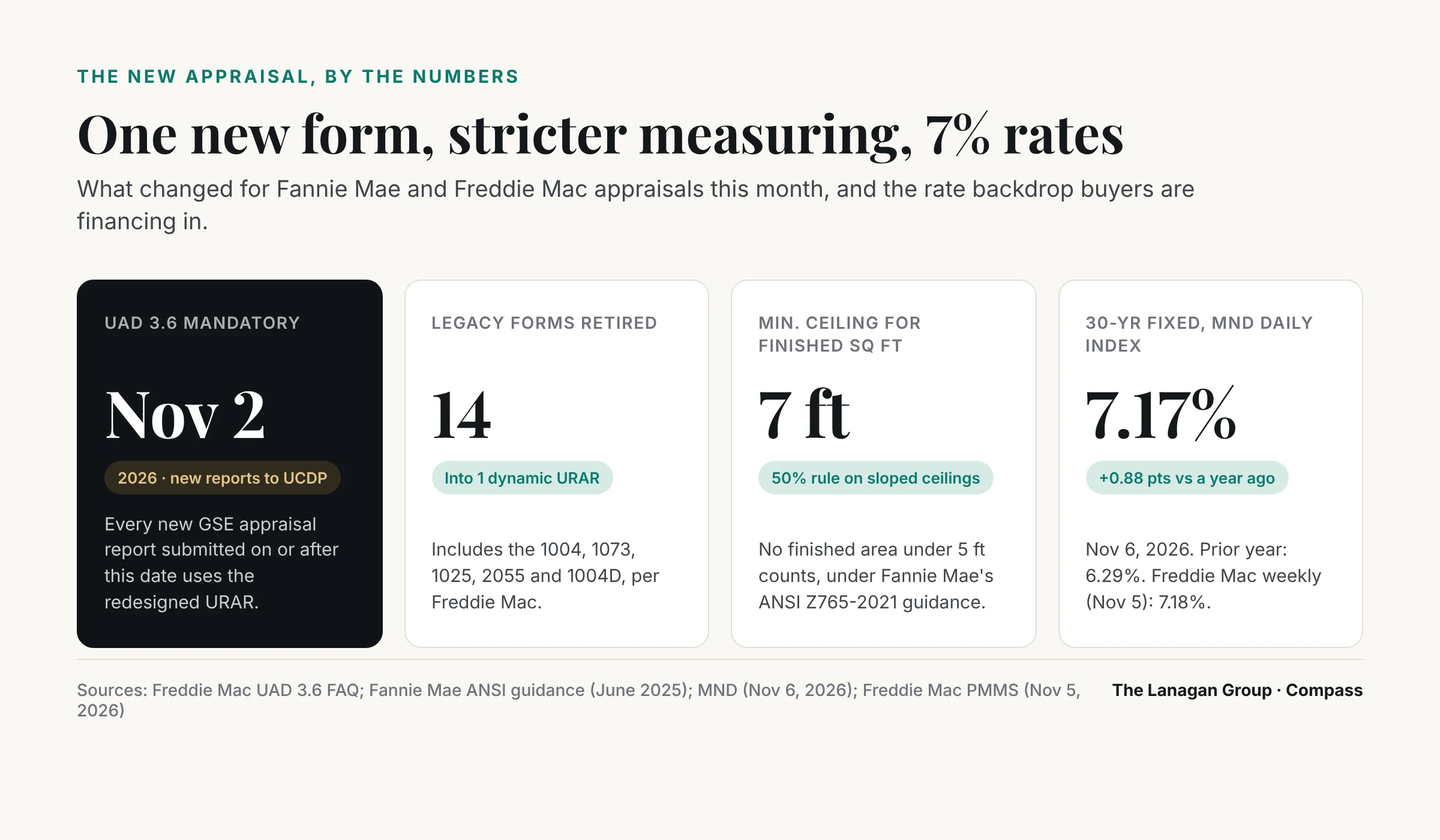
- Nov 2, 2026: the date UAD 3.6 became mandatory for new reports submitted to the GSEs’ portal (Freddie Mac FAQ). Fannie Mae opened broad production on January 26, 2026.
- 14 legacy forms retired, including the 1004, 1073, 1025, 2055 and 1004D, folded into one URAR (Freddie Mac).
- 7 ft minimum ceiling for space to count as finished square footage, and below-grade space is reported separately (Fannie Mae ANSI guidance, June 2025).
- 7.17%: the Mortgage News Daily 30-year fixed index on Nov 6, 2026, versus 6.29% a year earlier. Buyers financing at these rates have less spare cash to cover an appraisal gap.
- $20,000: in our example, the extra cash a buyer needs if a $650,000 home appraises $25,000 low (Lanagan Group calculation).
What exactly changed on November 2?
Here’s the timeline and the scope in plain terms. I’ve kept to what Fannie Mae and Freddie Mac publish, and labeled anything that comes from industry summaries.
| Item | What it means | Source |
|---|---|---|
| Jan 26, 2026 | Broad production: all lenders may submit UAD 3.6 reports | Fannie Mae announcement |
| Nov 2, 2026 | UAD 3.6 mandatory for all new reports submitted to UCDP, based on each report’s first submission date | Freddie Mac FAQ |
| Transition exceptions | Lenders that can’t meet the mandate must request a policy exception from each GSE to keep using the old format for a limited period | Freddie Mac FAQ |
| Forms retired | 1004, 1004 Desktop and Hybrid, 1073 (condo), 1075, 2055, 1004C, 2090, 2095, 1025 (2–4 units), 1007 rent schedule and 1004D, replaced by one URAR | Freddie Mac FAQ |
| FHA, VA, USDA | The GSEs built these agencies’ requirements into UAD 3.6, but each agency sets its own plan. Industry summaries report FHA and USDA accept the new report without requiring it yet, and VA has not adopted it. | Freddie Mac FAQ; Class Valuation, Nov 2, 2026 |
Table period: January–November 2026. Because the mandate keys off the report’s submission date, a home that went under contract in October can still get a new-form appraisal this month.
What will the appraiser look at more closely now?
The new URAR swaps the old free-text addendum for specific fields in every section. A few changes matter most for a Middle Tennessee seller:
- Interior and exterior ratings. The condition (C1–C6) and quality (Q1–Q6) scales didn’t change, but Freddie Mac says the definitions were rewritten, and interior and exterior now get their own ratings.
- Room-level updates. The form records update status for kitchens and baths, an overall update status for bathrooms and for flooring, plus component-level update and condition status. “We redid the kitchen in 2022” now lands in a field, not a footnote.
- ADUs. Size, condition, rooms and location of an accessory dwelling unit are captured. That’s relevant across Davidson County, where backyard cottages and detached garages with living space are common.
- Year built. It’s the year the original structure was finished. A 1950 East Nashville bungalow with a 2002 addition reports 1950, so the addition’s value has to be documented elsewhere.
- Ceilings. Ceiling height is measured at its highest point, and the style is recorded.
- Rental information. The old 1007 rent schedule now sits inside the URAR, which matters to investor buyers of duplexes and small multifamily.
Some vendors also describe new fields for energy features like solar, and for resilience features like fortified roofs or storm shelters. I haven’t seen those spelled out in the GSE pages I reviewed, so treat them as likely, not confirmed. Either way, if your home has them, put them on your update log.
How does ANSI measuring change my square footage?
This is where I see the most risk for sellers, and the most room to get ahead. Fannie Mae requires appraisers to measure to the ANSI Z765-2021 standard. Under its June 2025 guidance:
- Any space partly or completely below grade is reported as below-grade area, separate from above-grade living area.
- Finished space needs a ceiling of at least 7 feet. In a room with a sloped ceiling, at least 50% of the finished area must be 7 feet or higher, and nothing under 5 feet counts.
- Finished rooms reached only through unfinished space, like a bonus room off an unfinished attic, are reported separately as nonstandard finished area.
- Openings to the floor below, such as a two-story foyer, don’t count. Stairs count on the floor they descend from.
- Final square footage is reported to the nearest whole square foot.
Here’s why that matters. Franklin and Brentwood are full of homes with finished walkout basements and bonus rooms over the garage. A listing that totals every finished foot can advertise a number the appraiser will never report as living area.
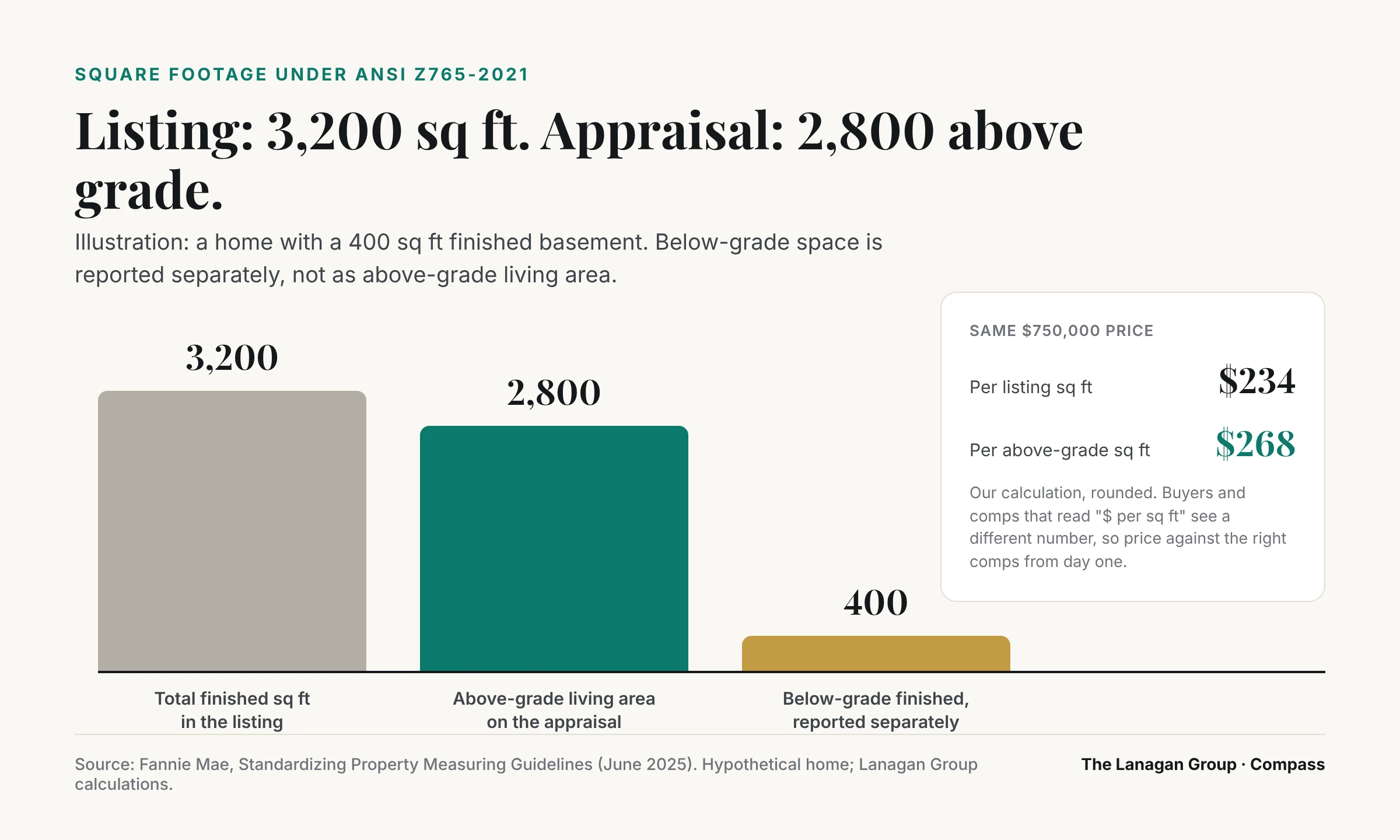
| Same $750,000 home | Square feet | Price per sq ft |
|---|---|---|
| Total finished (as listed) | 3,200 | $234 |
| Above-grade living area (appraisal) | 2,800 | $268 |
| Below-grade finished (reported separately) | 400 | n/a |
Illustration only; Lanagan Group calculations. A finished basement still has value. The appraiser just adjusts for it separately rather than counting it as living area.
The takeaway isn’t that your basement is worth less. It’s that your price has to be built on comps measured the same way. If we price a basement-heavy home against comps’ total square footage, we set the appraiser up to disagree with us. If we price it on above-grade area plus a separate basement adjustment, the appraisal is far more likely to land where the contract did.
What does a low appraisal cost the buyer, and why does that hurt the seller?
On a conventional loan, the lender lends against the lower of the price or the appraised value. When the appraisal comes in short, the buyer has to bring more cash, renegotiate or walk. At today’s rates, a lot of buyers are already stretching to cover their down payment.
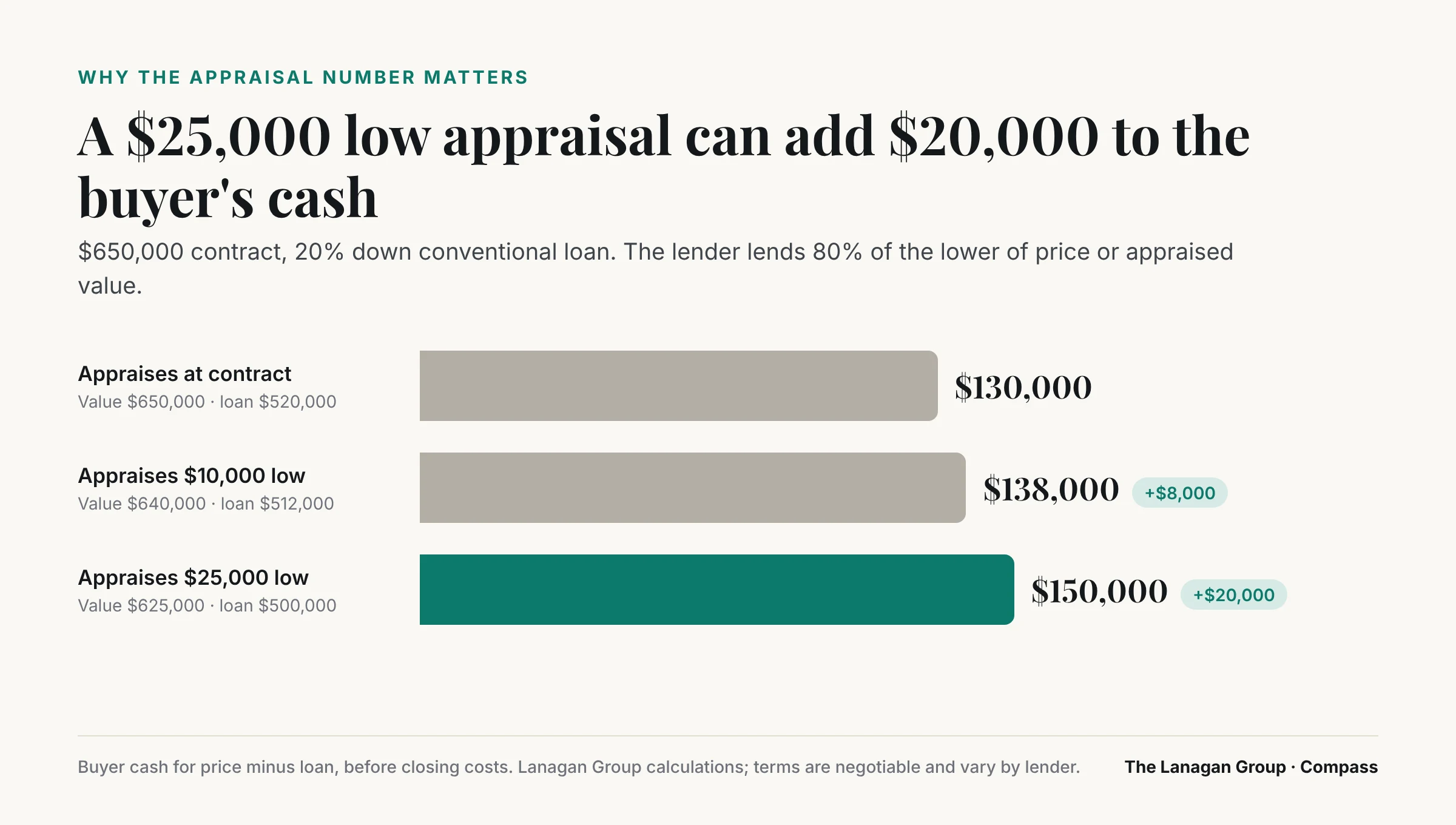
| Scenario ($650,000 price, 80% loan) | Appraised value | Max loan | Buyer cash | Extra cash |
|---|---|---|---|---|
| Appraises at contract | $650,000 | $520,000 | $130,000 | $0 |
| Appraises $10,000 low | $640,000 | $512,000 | $138,000 | $8,000 |
| Appraises $25,000 low | $625,000 | $500,000 | $150,000 | $20,000 |
Lanagan Group calculations. Excludes closing costs and prepaid items. Loan terms vary by lender, and how a gap gets resolved is always negotiable.
For context on rates: Mortgage News Daily’s daily 30-year fixed index was 7.17% on November 6, 2026, and Freddie Mac’s weekly survey was 7.18% for the week of November 5, its third straight weekly decline. That’s down from the 7.5%-plus levels we covered in our late-September rates post. The 10-year Treasury was about 4.87% on November 9 (Trading Economics), a spread of about 2.30 points, our calculation. Freddie Mac’s survey is weekly and lags fast moves, which is why I lead with the daily index. Easing rates bring buyers back. A home that appraises cleanly keeps them.
How do I prepare my home for the new appraisal?
This is the work we do on every listing now, before the sign goes in the yard.
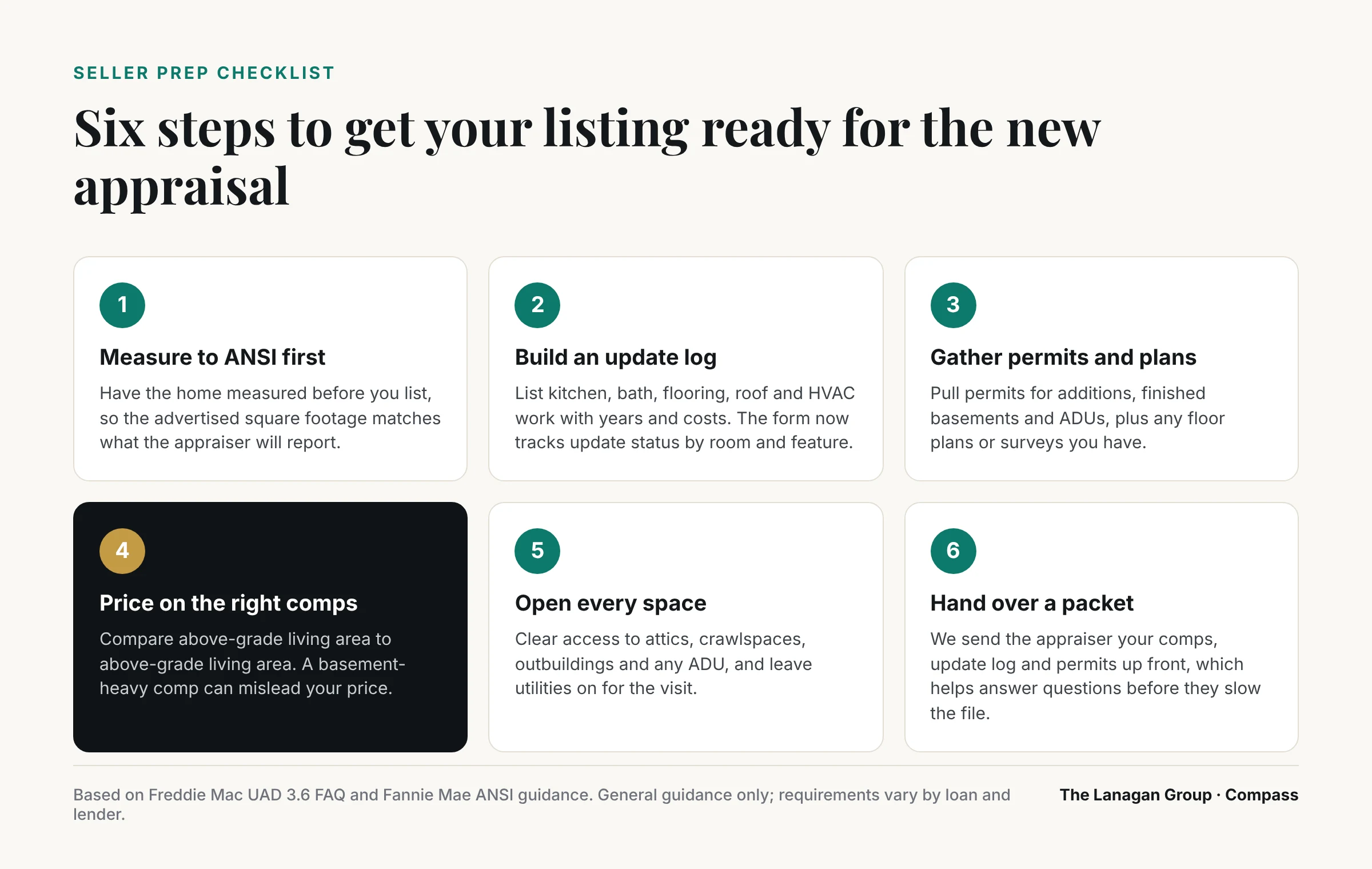
- Measure to ANSI before you list. Get a professional measurement and split it into above-grade, below-grade and any nonstandard area. Advertise numbers the appraiser will recognize.
- Build an update log. List each project by room: kitchen, baths, flooring, roof, HVAC, windows, water heater. Include the year and approximate cost. The form now asks for update status by room and component, so give the appraiser the answer.
- Gather permits, plans and surveys. Additions, finished basements, ADUs and converted garages are where questions come up. Permits from Metro Codes or your city back up the space you’re claiming.
- Price on the right comps. Match above-grade to above-grade and adjust for basements separately. This is the strategy work that keeps an appraisal from undercutting your contract. (More on that in our guide to pricing your Nashville home to sell.)
- Open every space. Make attics, crawlspaces, outbuildings and any ADU easy to reach, with the utilities on. A return visit costs days.
- Hand the appraiser a packet. On our listings, we send our comps, the update log and permits ahead of the visit. Appraisers work independently and make their own call. Good information just helps them make it faster.
Will appraisals take longer, and should I change my contract dates?
Possibly, at first. Lenders and appraisal firms expect a learning curve: industry summaries note longer initial completion times while appraisers adjust to the expanded data. Class Valuation says some transactions may take longer, but there’s “no universal requirement” to lengthen contract periods because of UAD 3.6. My practical advice: build a few extra days into the appraisal window when your buyer’s lender suggests it, and front-load the information above so your file isn’t the one waiting on answers. For sellers, a smooth appraisal is also leverage. A buyer who sees your packet knows the deal is less likely to wobble, which strengthens your hand in negotiation. If you’re comparing offers, read our guide to how buyers are using leverage in Nashville right now to see what you’re up against.
Does this matter if I’m selling to a relocating or investor buyer?
Yes, often more. Out-of-state buyers can’t walk the house five times, so they lean on the appraisal and the listing data to confirm value. Many of the families we help move here start with our county-by-county relocation guide, and they compare price per square foot across counties. Accurate square footage protects your credibility with them. Investor buyers of duplexes and small multifamily will see rent data in the same report now that the rent schedule is part of the URAR. I think of real estate as a long-term wealth tool, and clean documentation is part of what makes a property easy to buy, finance and eventually sell again.
Thinking about selling this winter?
If you’re planning to list in the next few months, the best time to prepare for the new appraisal is before you set a price. I’ll walk your home with you, flag any square footage or permit questions, and build a pricing strategy on comps measured the same way the appraiser will measure yours. You can start with a free home value request or just call me. Curious how we work? Read what clients say on Google and Zillow.
Frequently Asked Questions
What is UAD 3.6?
UAD 3.6 is the updated Uniform Appraisal Dataset that Fannie Mae and Freddie Mac use for appraisals on the loans they buy. It replaces older forms like the 1004 with one redesigned Uniform Residential Appraisal Report. It became mandatory for new reports submitted on or after November 2, 2026.
Does the new appraisal form change how my home is valued?
The valuation approach is the same, so the appraiser still relies on comparable sales and adjustments. What changes is how much detail gets recorded, from room-level updates to strict ANSI measurements. Better documentation makes it easier for the appraiser to support your price.
Does my finished basement count as square footage on an appraisal?
Under Fannie Mae’s ANSI guidance, any space partly or fully below grade is reported as below-grade area, separate from above-grade living area. It still adds value, and the appraiser adjusts for it separately. Price your home against comps measured the same way.
Does the new appraisal form apply to FHA and VA loans?
The mandate covers conventional loans sold to Fannie Mae and Freddie Mac. Freddie Mac says the GSEs built FHA, USDA and VA requirements into UAD 3.6, but each agency sets its own timing. Industry summaries report FHA and USDA accept the new report without requiring it, and VA hasn’t adopted it, so confirm with the buyer’s lender.
Will appraisals take longer under the new form?
Some may at first, because appraisers are collecting more data. Industry sources say there’s no universal need to extend contract periods. Giving the appraiser your measurements, update log and permits up front is the best way to avoid delays.
Can a seller give information to the appraiser?
Yes. Listing agents commonly provide comparable sales, a list of improvements and permits. The appraiser stays independent and decides what to use, but accurate information helps them value the home correctly.
What happens if my home appraises below the contract price?
The buyer’s loan is based on the lower value, so the buyer may need more cash, the price may be renegotiated, or both sides may split the difference. Your contract’s appraisal terms decide the options. In our $650,000 example, a $25,000 shortfall adds $20,000 to the buyer’s cash at 20% down.
Let’s get your home appraisal-ready
A strong strategy before you list is everything, and the new appraisal form makes that truer than ever. Call me at 615-707-0321 or email ethan@thelanagangroup.com, and let’s talk through your home, your timing and your price. You’ll never be just a transaction to us. We’re here long after closing.
About Ethan Lanagan
Ethan Lanagan is the founder and CEO of The Lanagan Group at Compass, a REALTOR® serving Middle Tennessee and Southern California who specializes in sales, marketing, and consulting to help clients grow their investment portfolios and find their dream homes.
Compass RE, 4031 Aspen Grove Dr Suite 400, Franklin, TN 37067 · TN #351977 (Compass) · CA #01967393 (Seven Gables)
Sources: Freddie Mac, UAD and Forms Redesign FAQ (updated Sept 30, 2026); Fannie Mae, broad production announcement (Jan 26, 2026); Fannie Mae, Uniform Appraisal Dataset; Fannie Mae, Standardizing Property Measuring Guidelines (June 2025); Class Valuation, New Appraisal Form FAQ (Nov 2, 2026); Reggora, UAD 3.6 overview (2026); Mortgage News Daily, 30-year fixed index (Nov 6, 2026); Freddie Mac PMMS (Nov 5, 2026); Trading Economics, US 10-year yield (Nov 9, 2026).
This article is general information only and does not constitute legal, tax, or financial advice. Confirm your specific numbers and requirements with your title company, tax advisor, or lender. Ethan Lanagan is a REALTOR® licensed in TN and CA, regulated by the Tennessee Real Estate Commission (TREC). The Lanagan Group is a real estate team affiliated with Compass RE, a licensed real estate broker. Equal Housing Opportunity.