


Mortgage rates jumped past 7.5% this week. Mortgage News Daily’s 30-year fixed index hit 7.58% on September 29, 2026, as the 10-year Treasury yield climbed to its highest level since 2007. On a median-priced Middle Tennessee home, that adds about $374 a month compared with a year ago. Nashville inventory is also higher and homes are taking longer to go under contract, so buyers who plan their financing before they write an offer have more room to negotiate than they’ve had in years.
How do higher mortgage rates change buying a home in Nashville this fall?
Higher rates make the same house cost more each month, but they also thin out the competition. In August 2026, Greater Nashville REALTORS® reported a residential median price of $515,725, up 2.1% from a year earlier, while closings fell 5.3% and homes took a median of 55 days from listing to contract, up from 49. For a buyer, that combination means payments are harder to carry and sellers are easier to negotiate with. The buyers who come out ahead this fall are the ones who treat the rate as something to negotiate around, not a reason to sit out.
Key Takeaways
- The Federal Reserve raised its benchmark rate by 0.25 points to a 3.75%–4.00% range on September 16, 2026, its first increase since 2023, and most officials projected one more hike before year-end, according to the Federal Reserve.
- The Mortgage News Daily 30-year fixed index reached 7.58% on September 29, 2026, up from 7.26% a week earlier and 6.38% a year ago. Freddie Mac’s weekly survey (7.03% on September 24) lags fast moves like this one.
- The 10-year Treasury yield, which mortgage rates follow most closely, rose to about 5.25% on September 29, 2026, its highest level since 2007, according to Trading Economics and market reports.
- With 10% down on a $515,725 home, principal and interest at 7.58% is about $3,271 a month, roughly $374 more than the same loan at last year’s 6.38% (my calculation, before taxes and insurance).
- Nine-county residential inventory reached 10,532 homes in August 2026, up 4.5% from a year earlier, and closings fell to 2,306 from 2,434, per Greater Nashville REALTORS®.
Why are mortgage rates climbing so fast?
On September 16, the Federal Open Market Committee voted 12–0 to raise the federal funds rate by a quarter point, citing inflation that remains above its 2% target. It was the first increase since 2023, and the committee’s projections pointed to one more hike before the end of 2026. The next scheduled decision is October 28.
But the Fed doesn’t set mortgage rates. The number to watch is the 10-year Treasury yield. Lenders price 30-year mortgages at a spread above it, because most home loans are paid off or refinanced in about 7 to 10 years. When investors demand more to hold 10-year government debt, mortgage rates follow within days.
That’s exactly what happened last week. The 10-year yield was 4.96% on September 22, per the Federal Reserve’s FRED data, and reached about 5.25% by September 29, the highest since 2007. Over roughly the same stretch, the Mortgage News Daily index went from 7.26% to 7.58%. Today the gap between the two is about 2.3 percentage points.
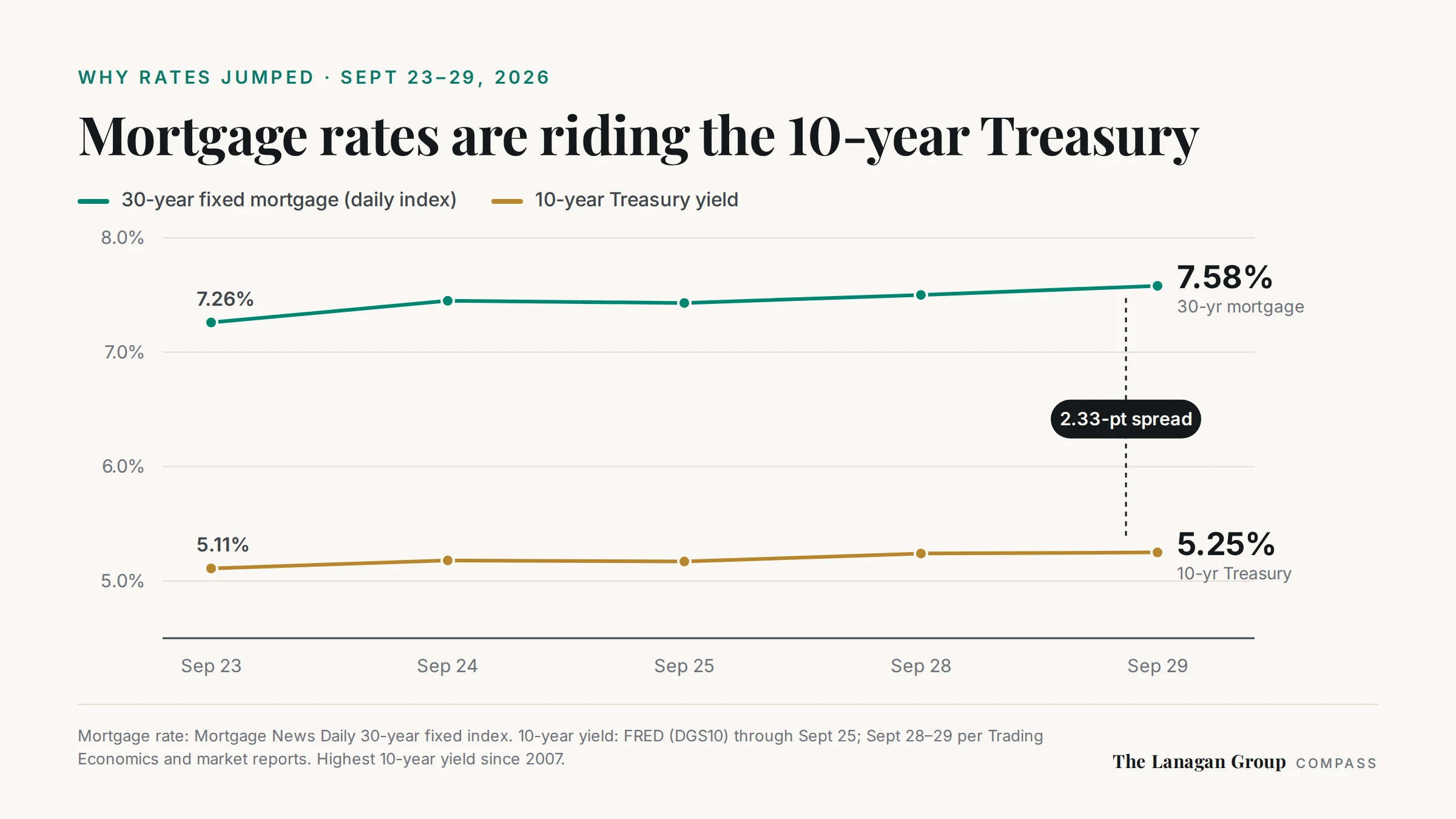
You’ll see different rates quoted depending on the source. Mortgage News Daily updates every business day from lender rate sheets. Freddie Mac’s widely cited survey is a weekly average of loan applications, which is why it showed 7.03% on September 24 while the daily index was already at 7.45%. In a fast-moving week, the daily number is closer to what a lender will quote you today. Neither is a quote for your loan, and a future Fed move can push rates either way. Nobody, including me, can reliably call the timing.
What does 7.5% actually cost a Nashville buyer each month?
Here’s the math on a home at the August 2026 nine-county median, with 10% down and a 30-year fixed loan. These figures are principal and interest only. Property taxes, homeowners insurance, and any HOA dues come on top and vary a lot by county.
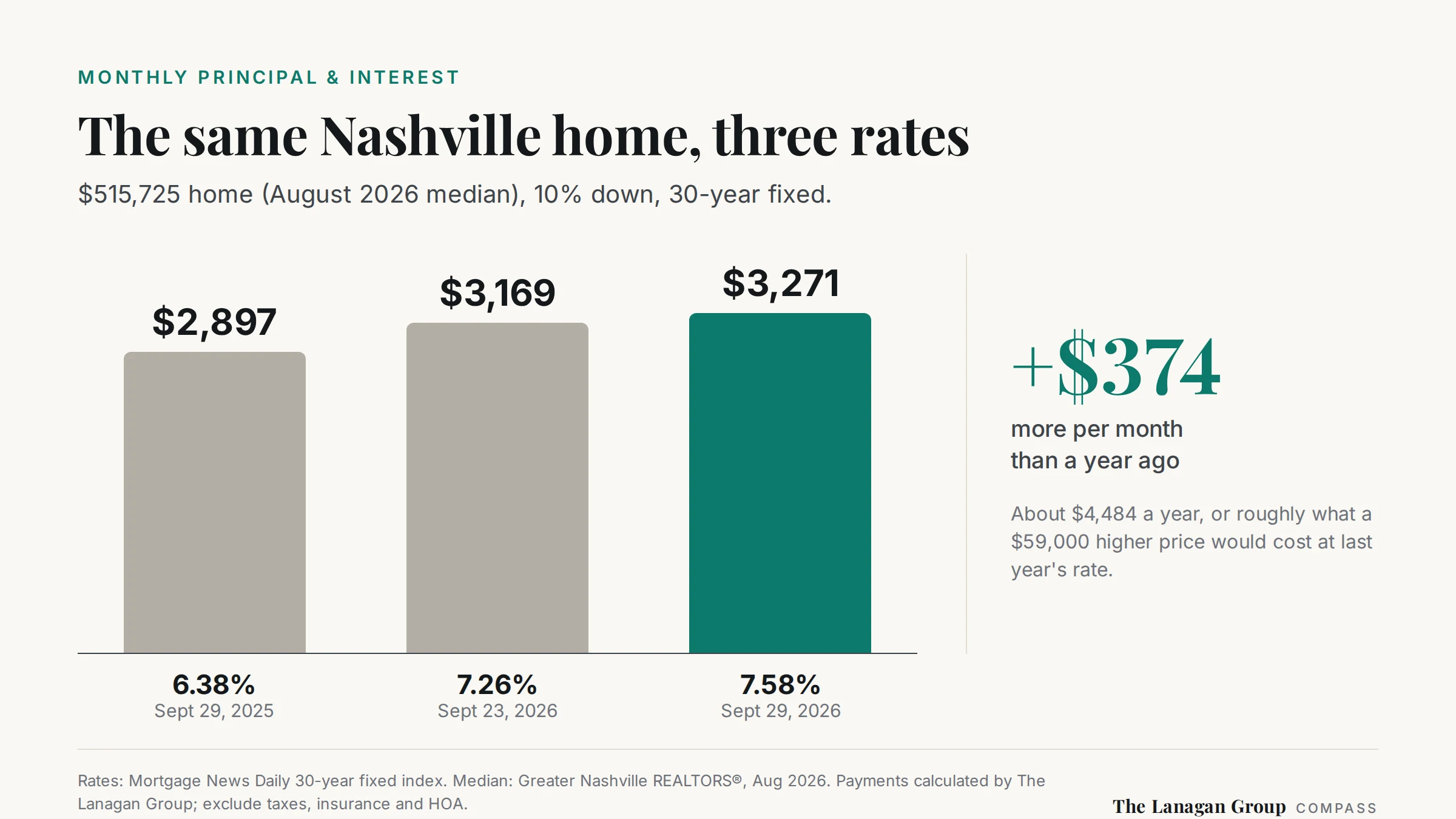
| 30-Year Rate | When | Monthly P&I on $464,153 Loan |
|---|---|---|
| 6.38% | September 29, 2025 | $2,897 |
| 7.26% | September 23, 2026 | $3,169 |
| 7.58% | September 29, 2026 | $3,271 |
Rates: Mortgage News Daily 30-year fixed index, daily. Loan amount assumes 10% down on the $515,725 August 2026 residential median reported by Greater Nashville REALTORS®. Payments are my calculation and exclude taxes, insurance, HOA dues, and mortgage insurance. Your rate depends on credit, loan type, and down payment.
Another way to see it: at 7.58%, the monthly payment that bought a $515,725 home at last year’s rate now buys about $457,000. In payment terms, rates did what a roughly $59,000 price increase would have done. That’s the number I’d have in mind when deciding how hard to push on price, because it’s the gap the market is quietly asking sellers to help close.
Is the Nashville market softer right now?
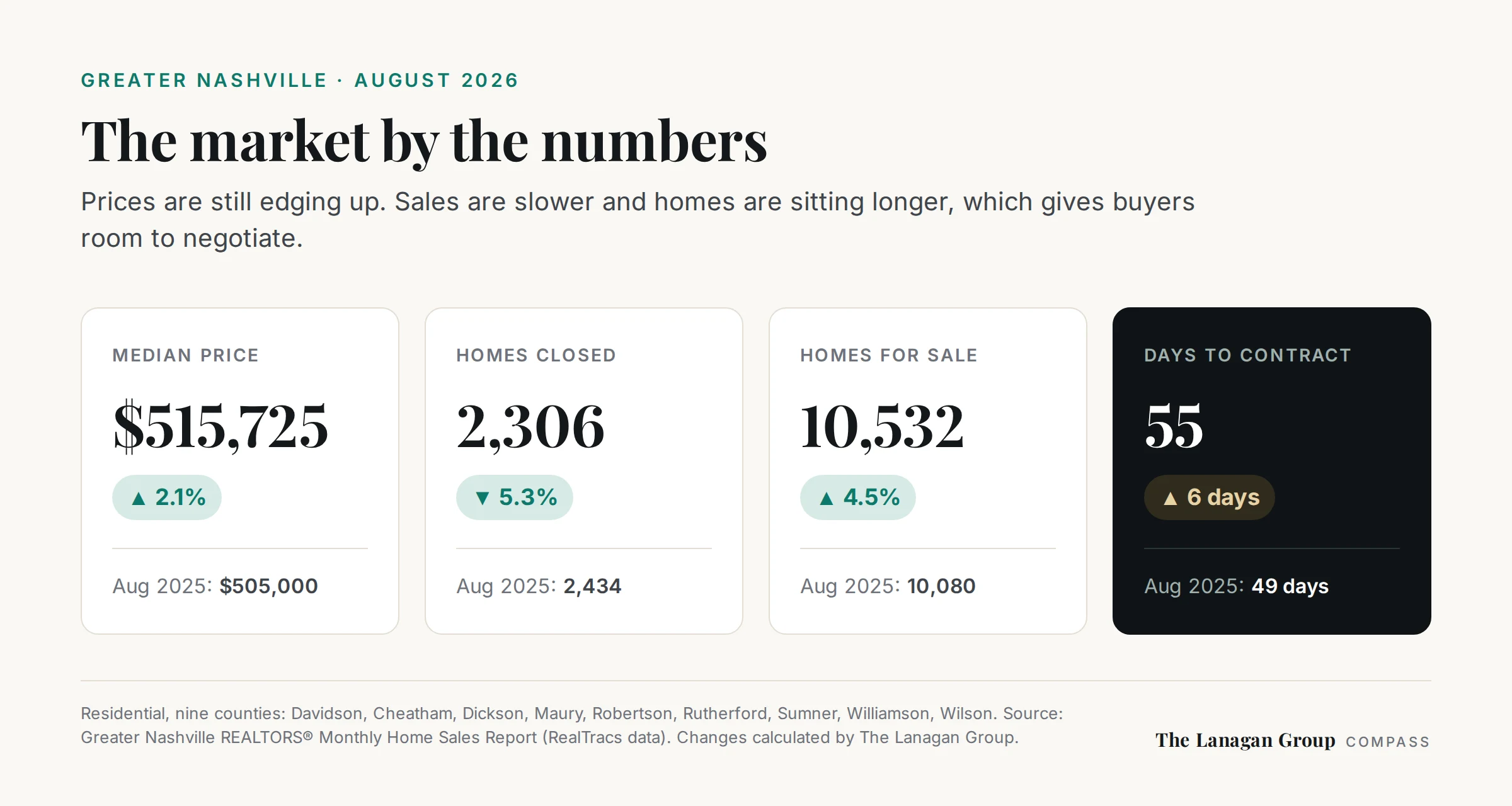
Yes, meaningfully. Greater Nashville REALTORS® tracks nine counties: Davidson, Cheatham, Dickson, Maury, Robertson, Rutherford, Sumner, Williamson, and Wilson. Here’s August 2026 against August 2025:
| Metric (9 counties) | August 2025 | August 2026 | Change |
|---|---|---|---|
| Residential closings | 2,434 | 2,306 | −5.3% |
| Residential median price | $505,000 | $515,725 | +2.1% |
| Condo median price | $353,450 | $339,995 | −3.8% |
| Residential inventory | 10,080 | 10,532 | +4.5% |
| Days, list to contract | 49 | 55 | +6 days |
Source: Greater Nashville REALTORS® Monthly Home Sales Report, August 2026, data from RealTracs. Percent changes are my calculation.
RealTracs data covering a slightly different 10-county footprint tells the same story from the supply side. August 2026 figures reported from that dataset show active inventory up 10% year over year to 14,294 homes and 5.59 months of supply, the first reading above five months in that series. Economists generally treat about six months as balanced. You’ll see a lower median, $450,000, in that dataset because it covers a different set of counties and property types. It isn’t a contradiction; it’s a different basket of homes.
One number cuts the other way. New listings in that 10-county data fell 18% year over year in August, to 5,537. Fewer sellers are putting homes on the market, which is part of why prices are still inching up even as sales slow. Homeowners with 3% and 4% mortgages are staying put. The practical result is more homes sitting unsold, but not a flood of new supply. Well-priced homes in the right locations still move. Franklin, for example, is still selling faster than the metro as a whole.
How can buyers use this market to their advantage?
In a competitive market like Nashville, having a strong strategy before you make an offer is everything, and that’s especially true when rates are moving week to week. Here’s the order I walk buyers through right now:
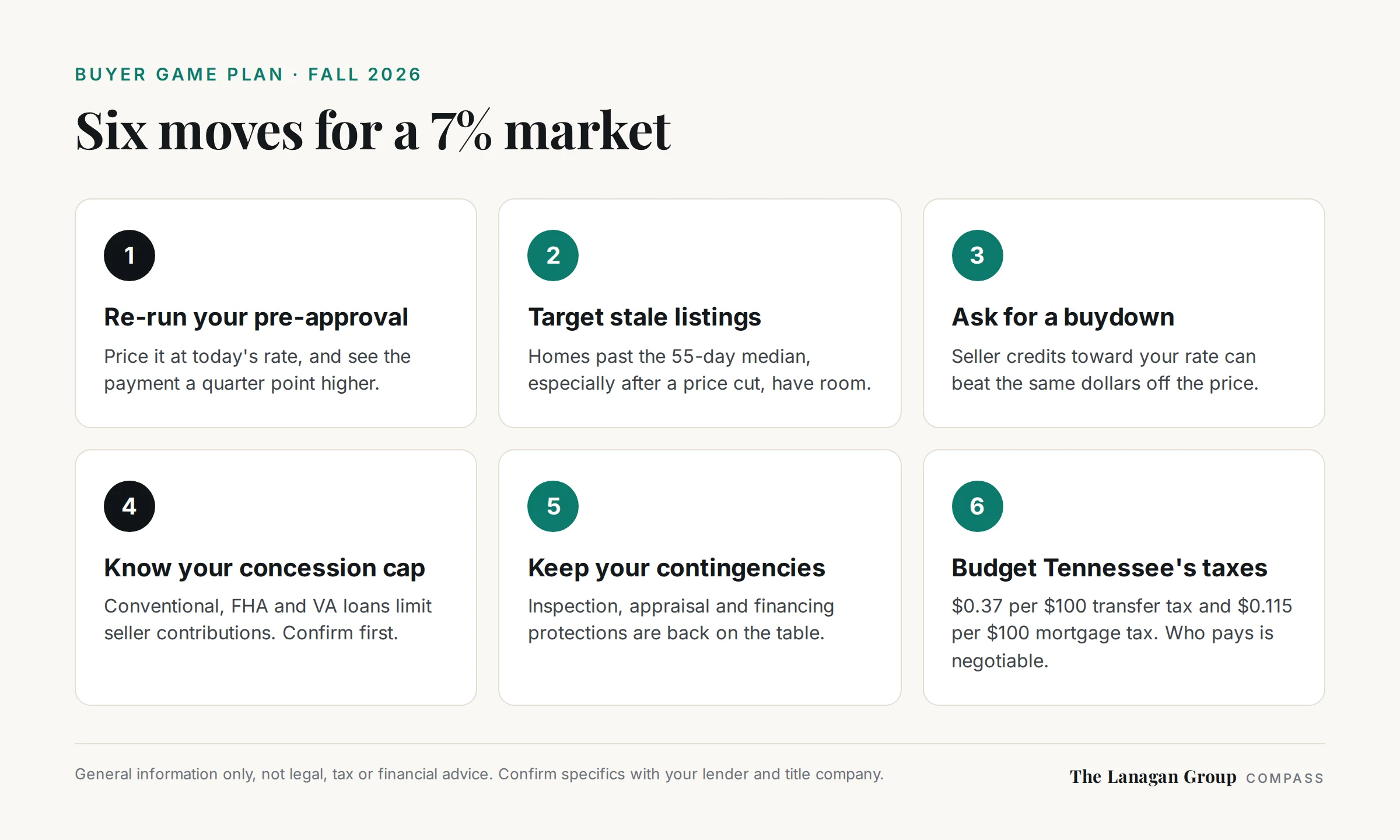
- Get a pre-approval at today’s rate, not last month’s. A pre-approval written when rates were 7% may overstate what you can carry at 7.5% or more. Ask your lender to rerun it and to show you the payment at a quarter point higher, so a bad week doesn’t blow up your budget mid-contract.
- Target homes past the neighborhood’s typical days on market. With the median now 55 days to contract, a listing at 70 or 80 days with a price reduction is a seller who’s thinking about carrying costs. That’s where the negotiating room is.
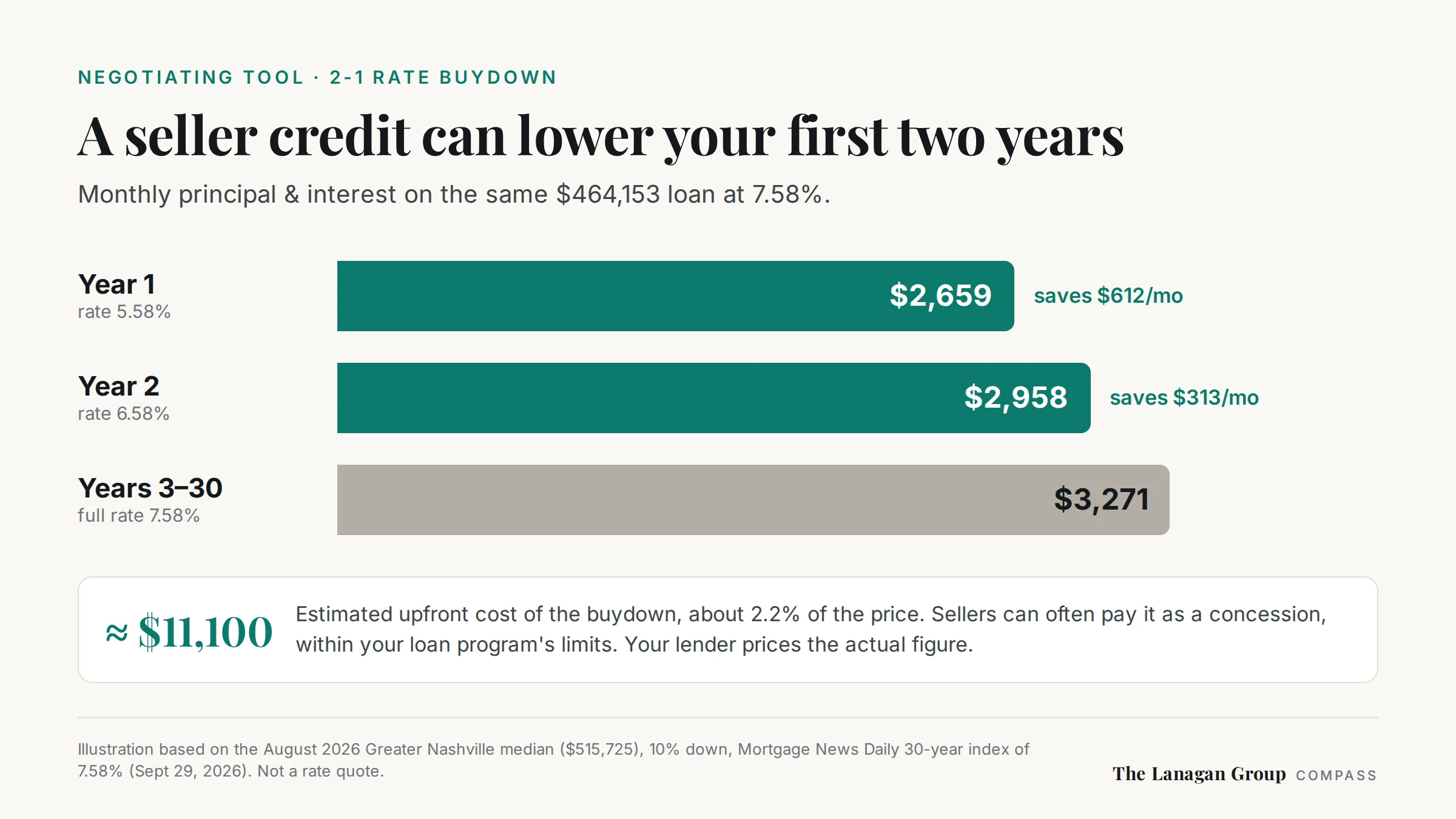
- Ask for a rate buydown instead of only a price cut. A seller credit used to buy down your rate often does more for your monthly payment than the same dollars off the price. On the median home above, a temporary 2-1 buydown would cost roughly $11,100, or about 2.2% of the price, and would bring year-one principal and interest to about $2,659 and year-two to about $2,958 before the full rate applies. A permanent buydown costs more but lasts the life of the loan. Your lender can price both options.
- Check your loan program’s concession limits first. Conventional, FHA, and VA loans each cap how much a seller can contribute, and the cap often depends on your down payment. An offer that asks for more than your loan allows wastes negotiating capital. Confirm the number with your lender before you write it into a contract.
- Keep your contingencies. Inspection, appraisal, and financing contingencies are back in most Middle Tennessee transactions. In a 55-day market, you rarely need to give them up to win a house.
- Remember the closing costs Tennessee sets by law. The state realty transfer tax is $0.37 per $100 of the purchase price and the mortgage tax is $0.115 per $100 of the loan amount, per the Tennessee Department of Revenue. On the median home above, that’s about $1,908 and $534. The rates are fixed, but who pays them is negotiable in your contract.
I walk through the full cash picture in Cash to Close in Nashville: What You Need in 2026, and more unconventional ways to structure an offer in Creative Buying Strategies for Nashville’s 2026 Market.
Should you wait for rates to come back down?
I’d be skeptical of anyone who tells you confidently which way rates are heading. The Fed’s own projections point to another hike this year, but mortgage rates can fall even while the Fed is raising if bond markets decide inflation is under control. What I can tell you is what waiting trades away. Right now, you’re competing with fewer buyers, sellers are open to credits, and inventory is the highest it’s been in years. If rates drop meaningfully, more buyers come back at once, and the negotiating room you have today tends to disappear with them.
The way I think about it: buy a home whose payment works at today’s rate, and treat a future refinance as a possible bonus rather than part of the plan. Refinancing has its own costs and depends on your credit, equity, and where rates actually land. If the numbers only work assuming a refinance, the house is too expensive for you right now. I always encourage buyers to look at real estate as a long-term wealth tool, and that only works if you can comfortably hold the home through whatever rates do next.
If you’re weighing whether an agent can actually move these numbers for you, I laid out what that work looks like in What a Nashville Buyer’s Agent Does in 2026.
You can read what past clients have said about working with me on Google and Zillow.
Frequently Asked Questions
What are mortgage rates in Nashville right now?
Mortgage rates are set nationally, not by city. Mortgage News Daily’s daily index put the average 30-year fixed rate at 7.58% on September 29, 2026, while Freddie Mac’s weekly survey, which lags fast moves, showed 7.03% on September 24. The rate you’re offered will depend on your credit, down payment, loan type, and lender, so get quotes from more than one lender.
Does the Fed rate hike raise my mortgage rate?
Not directly. The Fed sets a short-term rate for banks, while 30-year mortgage rates track the 10-year Treasury yield, which reached about 5.25% on September 29, 2026, its highest since 2007. Mortgage rates typically run about 2 to 3 percentage points above that yield. If you have an adjustable-rate mortgage or a HELOC, those can move more directly with the Fed’s rate.
Why do mortgage rates follow the 10-year Treasury?
Most 30-year mortgages are paid off or refinanced within about 7 to 10 years, so investors who buy mortgage bonds compare them to 10-year Treasuries. When the 10-year yield rises, mortgage rates usually follow within days. Watching the 10-year is the simplest way to see where rates are heading before lenders update their pricing.
Is it a buyer’s market in Nashville in fall 2026?
It’s close to balanced and leaning toward buyers. RealTracs data showed 5.59 months of supply across 10 Middle Tennessee counties in August 2026, and Greater Nashville REALTORS® reported homes taking a median of 55 days from listing to contract. Prices are still up slightly year over year, so it isn’t a market where values are falling, but buyers have real leverage on terms, credits, and contingencies.
What is a 2-1 buydown, and can a seller pay for it?
A 2-1 buydown lowers your rate by two points in the first year and one point in the second, with the full rate starting in year three. The cost is paid upfront, and a seller can often fund it as a concession, within the limits your loan program sets on seller contributions. Your lender can price it and confirm how much a seller is allowed to contribute on your loan.
How much has the monthly payment on a Nashville home gone up?
With 10% down on the August 2026 nine-county median of $515,725, principal and interest at 7.58% comes to about $3,271 a month. At last September’s 6.38%, the same loan was about $2,897, a difference of roughly $374 a month or $4,484 a year. Taxes, insurance, and any HOA dues are on top of those figures.
Should I wait to buy until mortgage rates drop?
That depends on your timeline and finances, and nobody can reliably predict when rates will fall. Waiting may bring a lower rate, but it can also mean more competition and fewer seller concessions if buyers return in force. A safer approach is to buy only if the payment works at today’s rate and treat any future refinance as a bonus.
Every buyer’s numbers are different, and the right strategy depends on your loan, your timeline, and the specific homes you’re looking at. If you’re thinking about buying in Nashville, Franklin, or anywhere in Middle Tennessee this fall, schedule a consultation with me. We’ll run your payment at today’s rate, look at which listings have room to negotiate, and build an offer strategy before you tour a single home.
This article is general information only and does not constitute legal, tax, or financial advice. Confirm your specific numbers and requirements with your title company, tax advisor, or lender. Ethan Lanagan is a REALTOR® licensed in TN and CA, regulated by the Tennessee Real Estate Commission (TREC). The Lanagan Group is a real estate team affiliated with Compass RE, a licensed real estate broker. Equal Housing Opportunity.