


The short answer: Yes. By Redfin’s measure, Nashville was the strongest buyer’s market in the country in August 2026, with 139% more sellers than buyers, and roughly three in five Nashville sellers gave buyers a concession. That leverage is real, and the buyers who use it well ask for the right things: seller credits toward a lower rate or closing costs, repairs after inspection, and full contract protections. Here’s how to do it.
Is Nashville a buyer’s market right now?
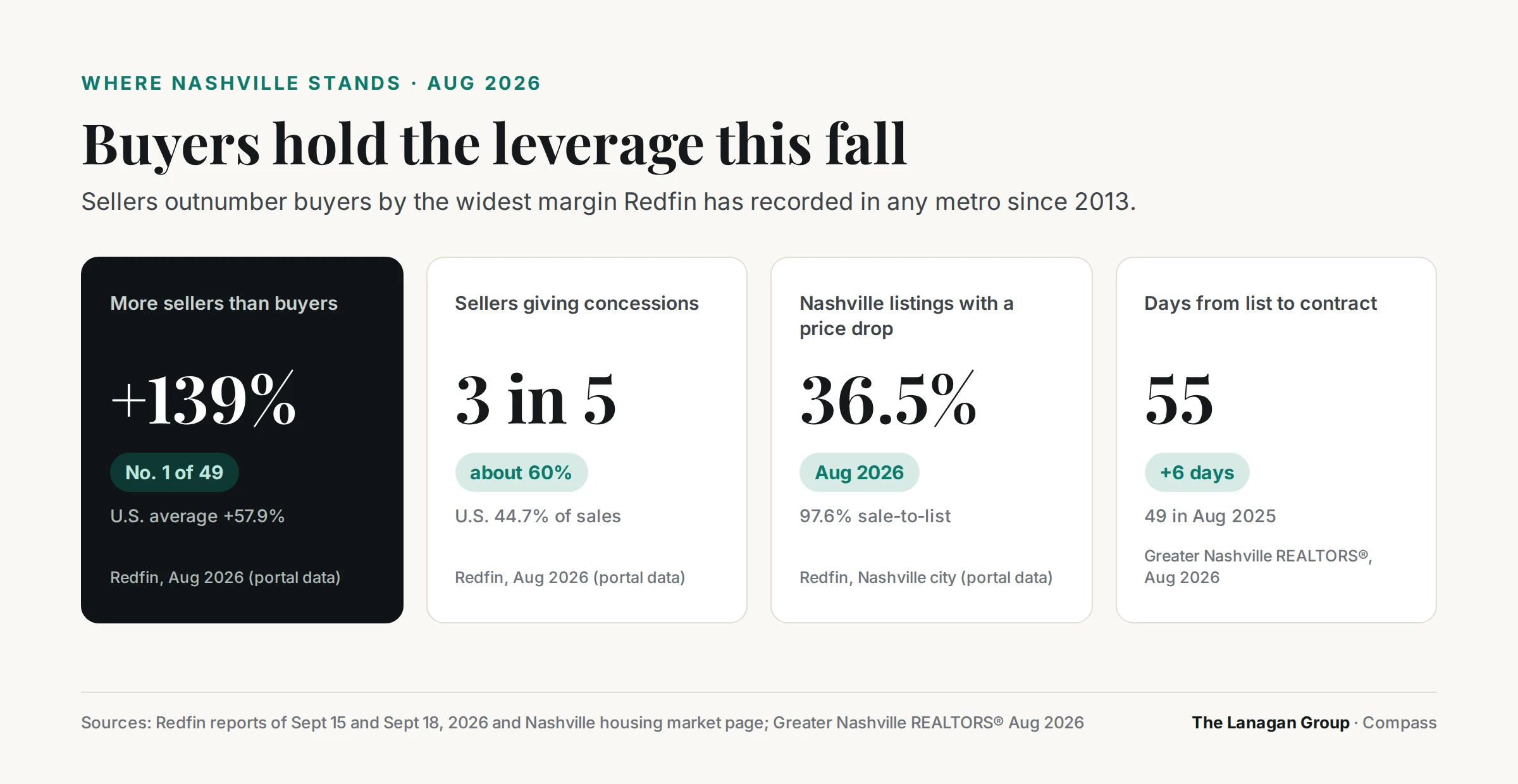
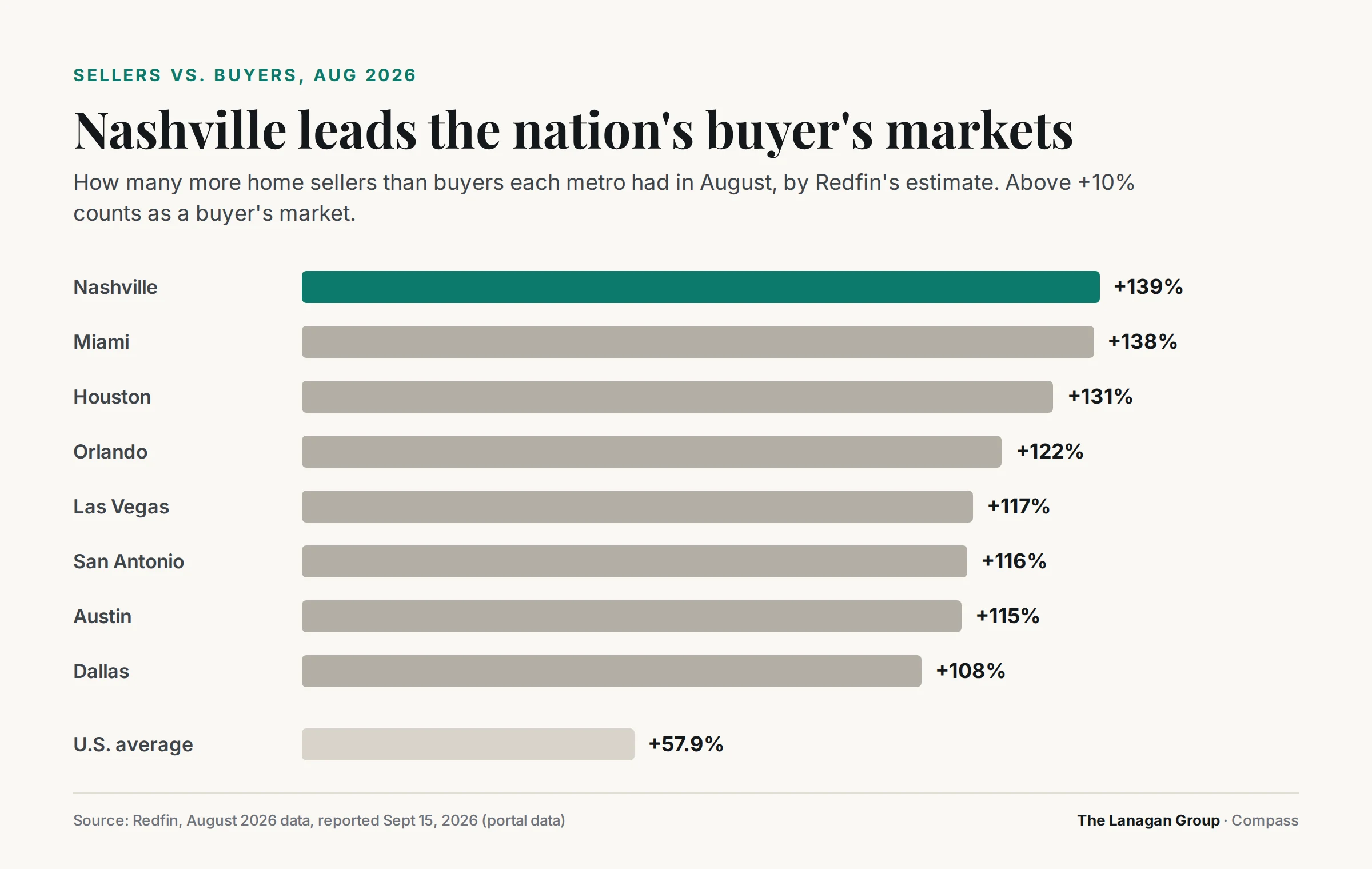
Yes, and by some measures it’s the strongest one in the country. Redfin estimated that the Nashville metro had 139% more home sellers than buyers in August 2026, the widest gap it has recorded in any metro since its data begins in 2013 and No. 1 of the 49 metros it analyzed. Local MLS data points the same way: homes are taking longer to go under contract, more listings are getting price cuts, and sellers are paying toward buyers’ costs. For buyers who have been waiting for a market that lets them negotiate, this is it. The key is knowing what to ask for, because the best deal isn’t always the lowest price.
Key Takeaways
- No. 1 buyer’s market: Nashville had 139% more sellers than buyers in August 2026, versus 57.9% nationally (Redfin, reported Sept. 15, 2026).
- Concessions are common: roughly three in five Nashville sellers gave buyers a concession in August, compared with 44.7% of sales nationally (Redfin, Sept. 18, 2026).
- Homes are sitting longer: the median time from list to contract rose to 55 days from 49 a year earlier (Greater Nashville REALTORS®, August 2026).
- A credit can beat a price cut: by our calculation, a $15,000 seller credit used for a 2-1 buydown lowers a median-priced home’s first-year payment by $613 a month, versus $95 for a $15,000 price cut.
- Know the cap: Fannie Mae limits seller contributions on a primary home to 3%, 6% or 9% of the price, depending on your down payment.
What do the numbers show?
Redfin’s August 2026 analysis counts a metro as a buyer’s market when it has more than 10% more sellers than buyers. Nashville’s 139% was the highest of the 49 metros Redfin studied, just ahead of Miami at 138%. In a separate report on September 18, Redfin found that roughly three in five Nashville sellers gave a concession in August, placing Nashville among the top concession markets of the 29 metros it tracked. Redfin’s Nashville city data shows 36.5% of homes for sale had a price drop in August and homes sold for 97.6% of list price on average. These are portal figures, so read them alongside the MLS numbers below.
The Greater Nashville REALTORS® August report, the same one I used in last week’s post on what buyers should do with rates above 7.5%, shows the shift across its nine counties:
| Measure (9 counties) | August 2025 | August 2026 | Change |
|---|---|---|---|
| Residential inventory | 10,080 | 10,532 | +4.5% |
| Days, list to contract (median) | 49 | 55 | +6 days |
| Residential closings | 2,434 | 2,306 | −5.3% |
| Residential median price | $505,000 | $515,725 | +2.1% |
Source: Greater Nashville REALTORS® monthly report, August 2026 (Davidson, Cheatham, Dickson, Maury, Robertson, Rutherford, Sumner, Williamson and Wilson counties). The September report is due in early October.
Why do some sources call the market “balanced” instead?
Because they measure different things. Months of supply asks how long it would take to sell every listing at the current pace. RealTracs data for a 10-county area showed 5.59 months of supply in August 2026, as reported by Grant Hammond, up from 4.92 in July. The National Association of Home Builders describes 4.5 to 6 months as a balanced market, so the region sits at the buyer-friendly end of balanced and is moving toward buyers. Redfin’s ranking instead compares estimated active sellers with active buyers, and its Davidson County report put months of supply above six. Either way, the direction is the same: buyers have more choice and more room to negotiate than at any point in years.
Leverage also varies by area. Redfin’s Williamson County data for the three months ending in July shows 20.0% of listings with a price drop, versus 36.5% in Nashville proper, so expect less room in Franklin and Brentwood than in parts of Davidson, Rutherford or Sumner. Neighborhood-level days on market will tell you more than any regional headline.
Should you ask for a lower price or a seller credit?
For most buyers using a mortgage, a credit goes further in the early years. Here’s the math on a home at the August median of $515,725 with 10% down, at the 7.60% 30-year rate Mortgage News Daily posted on September 30, 2026. These are my calculations, not a loan quote.
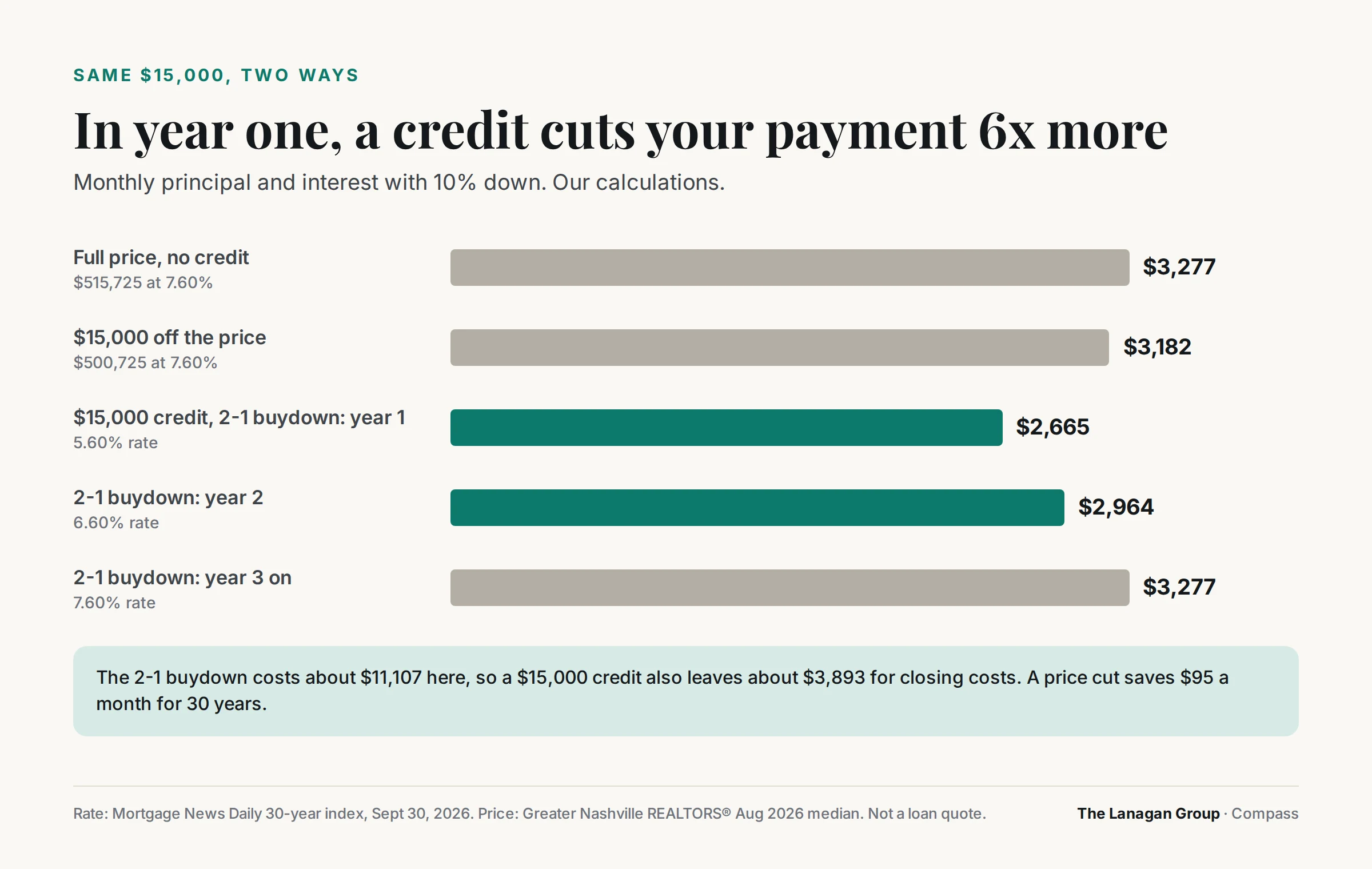
| Option (our calculations) | Monthly P&I | Savings vs. full price |
|---|---|---|
| Full price, $515,725 at 7.60% | $3,277 | — |
| $15,000 off the price ($500,725) | $3,182 | $95 a month for 30 years, plus $1,500 less down payment |
| $15,000 credit, 2-1 buydown, year 1 (5.60%) | $2,665 | $613 a month |
| 2-1 buydown, year 2 (6.60%) | $2,964 | $313 a month |
| 2-1 buydown, year 3 onward (7.60%) | $3,277 | — |
10% down, 30-year fixed, principal and interest only. A 2-1 buydown’s cost equals the payment difference over its first 24 months: about $11,107 here, leaving about $3,893 of a $15,000 credit for closing costs. Last week’s post put the buydown at about $11,100 and year one at $2,659 using the September 29 rate of 7.58%; today’s figures use September 30’s 7.60%. Rates change daily.
A price cut still has advantages: it lowers your loan, your down payment and your property tax base for good, and it helps if the home appraises low. The right mix depends on how long you plan to stay and whether you expect to refinance. Many of my clients ask for both, a modest price reduction plus a credit, and the current market supports that conversation.
How much can a seller contribute?
Lenders cap seller contributions, and the cap depends on your loan and down payment. For conventional loans, Fannie Mae’s Selling Guide B3-4.1-02 sets these limits for a primary residence or second home, calculated on the lower of the price or the appraised value:
| Your down payment (loan-to-value) | Max seller contribution | On a $515,725 home |
|---|---|---|
| Less than 10% down (over 90% LTV) | 3% | $15,472 |
| 10% to 24.99% down (75.01%–90% LTV) | 6% | $30,944 |
| 25% or more down (75% LTV or less) | 9% | $46,415 |
Dollar amounts are our calculations. FHA, VA and USDA loans have their own limits; investment properties are capped at 2% under Fannie Mae rules. Anything above the cap is treated as a price reduction. Confirm your limit with your lender before you write the offer.
Seller credits can cover closing costs, prepaid items and rate buydowns, but they can’t be paid to you as cash. Tennessee’s state taxes are part of that picture: the realty transfer tax is $0.37 per $100 of price and the mortgage tax is $0.115 per $100 of loan amount under Tennessee Department of Revenue rates. On our example, that’s about $1,908 and $534. Who pays each one is negotiable in your contract. For a full breakdown, see Cash to Close in Nashville: What You Need in 2026.
How do you write an offer that uses your leverage?
In a competitive market like Nashville, a strong strategy before making an offer is everything, and that’s still true when the market favors you. These are the steps I walk clients through.
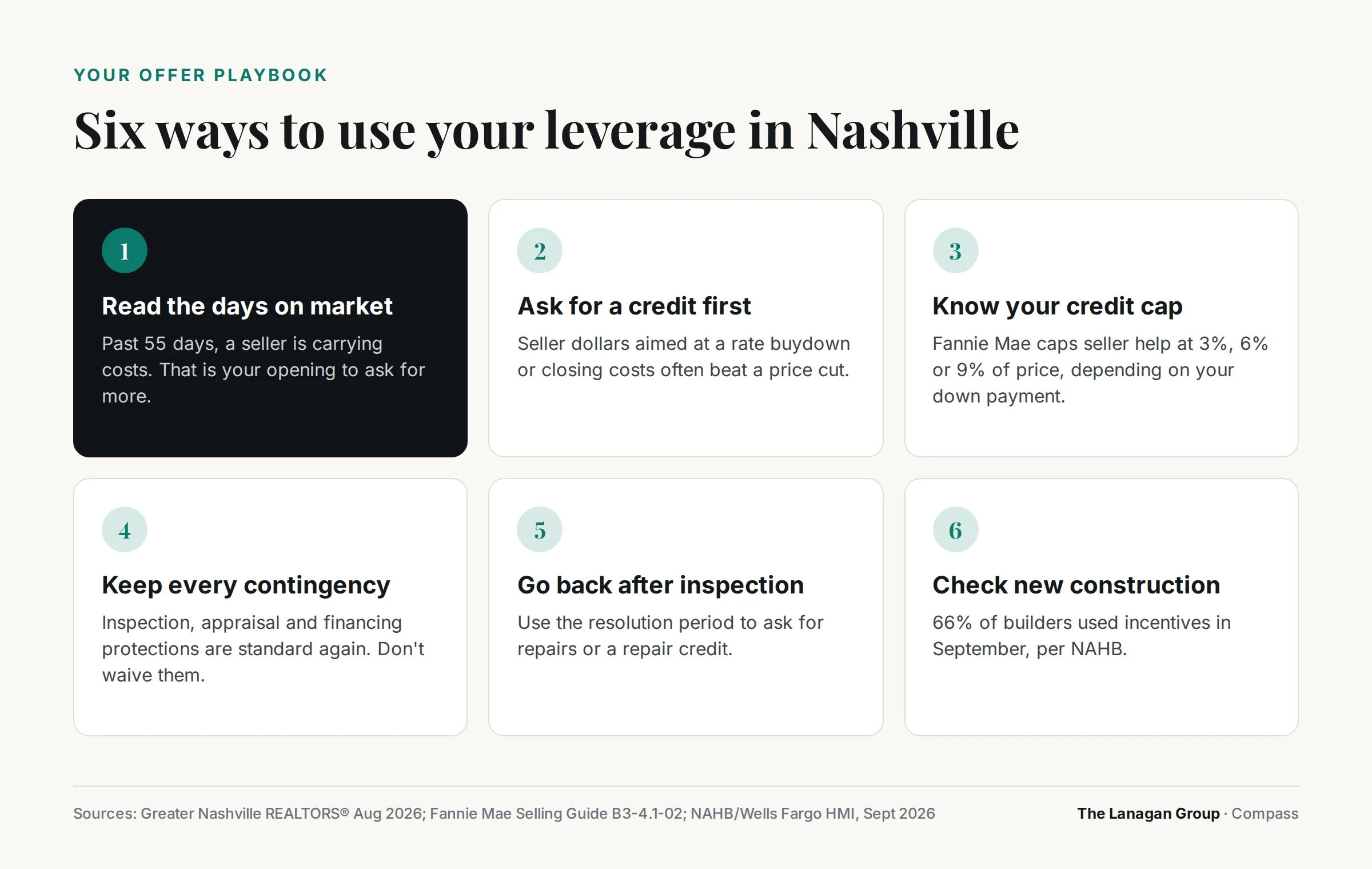
- Read the days on market. With the regional median at 55 days to contract, a home well past its neighborhood’s norm, especially one with a price reduction already, is a seller ready to talk. I pull days on market and price history for every home we tour.
- Ask for a credit first. Decide what matters most to you, a lower payment now or a lower balance long-term, and structure the ask around it. Often that’s a credit toward a buydown or closing costs, sometimes paired with a price reduction.
- Know your credit cap. Size your request to your loan’s limit so no money is left on the table. On a 10%-down conventional loan, that’s up to 6% of the price.
- Keep every contingency. Inspection, appraisal and financing protections are back in most Middle Tennessee contracts. In this market there’s rarely a reason to waive them, and they protect your earnest money.
- Go back after inspection. Tennessee purchase agreements typically include an inspection period and a resolution period. That’s the time to ask for repairs or a repair credit based on what the inspector finds.
- Check new construction. In the NAHB/Wells Fargo Housing Market Index for September 2026, 66% of builders nationally used sales incentives and 38% cut prices, by an average of 6%. Builder incentives often come tied to their preferred lender, so compare the full package.
One more edge: off-market and private exclusive listings can give serious buyers a real advantage, because you can negotiate with a motivated seller before the home hits the open market.
Should you buy now or wait for rates to fall?
Nobody can promise where rates will go. The Federal Reserve raised its target range to 3.75%–4.00% on September 16, and the 30-year rate has risen from 6.37% a year ago to 7.60%. What is clear is that today’s leverage depends on today’s conditions. If rates fall meaningfully, more buyers tend to return at once, and the credits, price cuts and repair concessions available now can shrink quickly. Buying with a payment that works at today’s rate, plus a seller-funded buydown, lets you capture this market’s leverage while keeping the option to refinance later if rates allow. A refinance is never guaranteed, so plan around a payment you can carry at the full rate.
If you’re ready to see what your leverage looks like on real homes, I’d love to help you build the offer. Here’s what a Nashville buyer’s agent does in 2026, and you can read what clients say on Google and Zillow. For me, the relationship doesn’t end at closing; I’m here for every question that comes after.
Frequently Asked Questions
Is Nashville a buyer’s market in 2026?
Yes. Redfin ranked the Nashville metro the No. 1 buyer’s market of 49 U.S. metros in August 2026, with 139% more sellers than buyers. Regional MLS data shows 5.59 months of supply and a 55-day median time to contract, which puts the area at the buyer-friendly end of balanced and trending toward buyers.
Are Nashville home prices dropping?
Not across the board. The Greater Nashville REALTORS® median residential price was $515,725 in August 2026, up 2.1% from a year earlier, while Redfin reported 36.5% of Nashville listings had a price drop. Individual homes, especially those sitting longer than their neighborhood norm, are where buyers are negotiating the biggest reductions.
How much can I negotiate off a house in Nashville right now?
It depends on the home, but sellers are giving more than they have in years. Redfin’s Nashville data shows homes selling for 97.6% of list price on average in August 2026, and roughly three in five sellers gave a concession. Days on market and price history are the best guides for how much room a specific seller has.
What is a seller concession?
A seller concession is money the seller contributes toward your costs, such as closing costs, prepaid taxes and insurance, or a mortgage rate buydown. It’s written into the purchase contract and credited at closing. Lenders cap how much a seller can contribute based on your loan type and down payment.
Is it better to get a seller credit or a lower price?
For many buyers, a credit used for a rate buydown lowers the payment more in the early years. In our example, a $15,000 credit funding a 2-1 buydown saved $613 a month in year one, versus $95 a month for a $15,000 price cut. A price cut lowers your loan balance and property taxes permanently, so the best choice depends on your plans.
What is a 2-1 buydown?
A 2-1 buydown lowers your interest rate by two percentage points in the first year and one point in the second, then the full rate applies from year three. The cost is paid upfront, often by the seller as a credit, and equals the payment savings over those 24 months. On a $464,153 loan at 7.60%, that’s about $11,107 by our calculation.
Should I waive the inspection to make my offer stronger in Nashville?
In today’s market, there’s rarely a reason to. With more sellers than buyers, inspection, appraisal and financing contingencies are standard again in most Middle Tennessee transactions. Keeping them protects your earnest money and gives you a chance to negotiate repairs after the inspection.
Ready to put this market to work for you? Call or text me at 615-707-0321 or email ethan@thelanagangroup.com, and we’ll find the homes with the most room to negotiate, including private exclusives you won’t see online.
About Ethan Lanagan
Ethan Lanagan is the founder and CEO of The Lanagan Group at Compass, a REALTOR® serving Middle Tennessee and Southern California who specializes in sales, marketing, and consulting to help clients grow their investment portfolios and find their dream homes.
The Lanagan Group at Compass · 4031 Aspen Grove Dr Suite 400, Franklin, TN 37067 · 615-707-0321 · TN License #351977 (Compass) · CA License #01967393 (Seven Gables)
This article is general information only and does not constitute legal, tax, or financial advice. Confirm your specific numbers and requirements with your title company, tax advisor, or lender. Ethan Lanagan is a REALTOR® licensed in TN and CA, regulated by the Tennessee Real Estate Commission (TREC). The Lanagan Group is a real estate team affiliated with Compass RE, a licensed real estate broker. Equal Housing Opportunity.