


Short answer: Yes, you can sell a home in Nashville this fall and come out ahead, but the seller who wins is the one who makes the buyer’s monthly payment work, not just the one who cuts the price. With the 30-year rate at 7.57% (Mortgage News Daily, Oct. 2, 2026), a seller-paid 2-1 rate buydown costing about $11,093 lowers a typical buyer’s first-year payment by about $612 a month, while a $15,000 price cut lowers it by about $95 (our calculations). Price it right from day one, market the payment, and negotiate from a plan.
Can you still sell a home in Nashville this fall?
Yes. Buyers are still signing contracts: 2,306 homes closed across the nine-county Greater Nashville REALTORS® area in August 2026, and new contracts in the 10-county RealTracs area were up 1% from a year earlier even as rates climbed. What has changed is who holds the leverage. Redfin counted 139% more sellers than buyers in the Nashville metro in August, and 63.1% of Nashville sales included a seller concession. That means the homes that sell are the ones priced for today’s market and packaged so a buyer can afford the payment at a 7.5%-plus rate. If you plan for that before you list, you can sell on your timeline instead of chasing the market down with price cuts.
Key Takeaways
- Buyers are still buying: 2,306 closings in the nine-county Greater Nashville REALTORS® area in August 2026, and RealTracs new contracts up 1% year over year (10 counties).
- Rates are the obstacle, not demand alone: the Mortgage News Daily 30-year fixed index was 7.57% on Oct. 2, 2026, versus 6.36% a year earlier.
- A buydown can do more than a price cut: by our calculation, $11,093 toward a 2-1 buydown trims a median-priced buyer’s year-one payment by about $612 a month; a $15,000 price cut trims it by about $95.
- There are limits: Fannie Mae caps seller contributions at 3%, 6% or 9% of the price for a primary home, depending on the down payment, and 2% for an investment property.
- Pricing still decides it: homes took a median 55 days to go under contract in August 2026, up from 49 a year earlier (Greater Nashville REALTORS®).
What are Nashville buyers seeing right now?
Buyers have more choice and more time than they’ve had in years. The numbers below are the most recent complete monthly data. Greater Nashville REALTORS® typically releases its September report in early October; I’ll update our market reports page when it’s out. Area medians here are for orientation only. Your street, school zone and condition matter more than any metro-wide number.
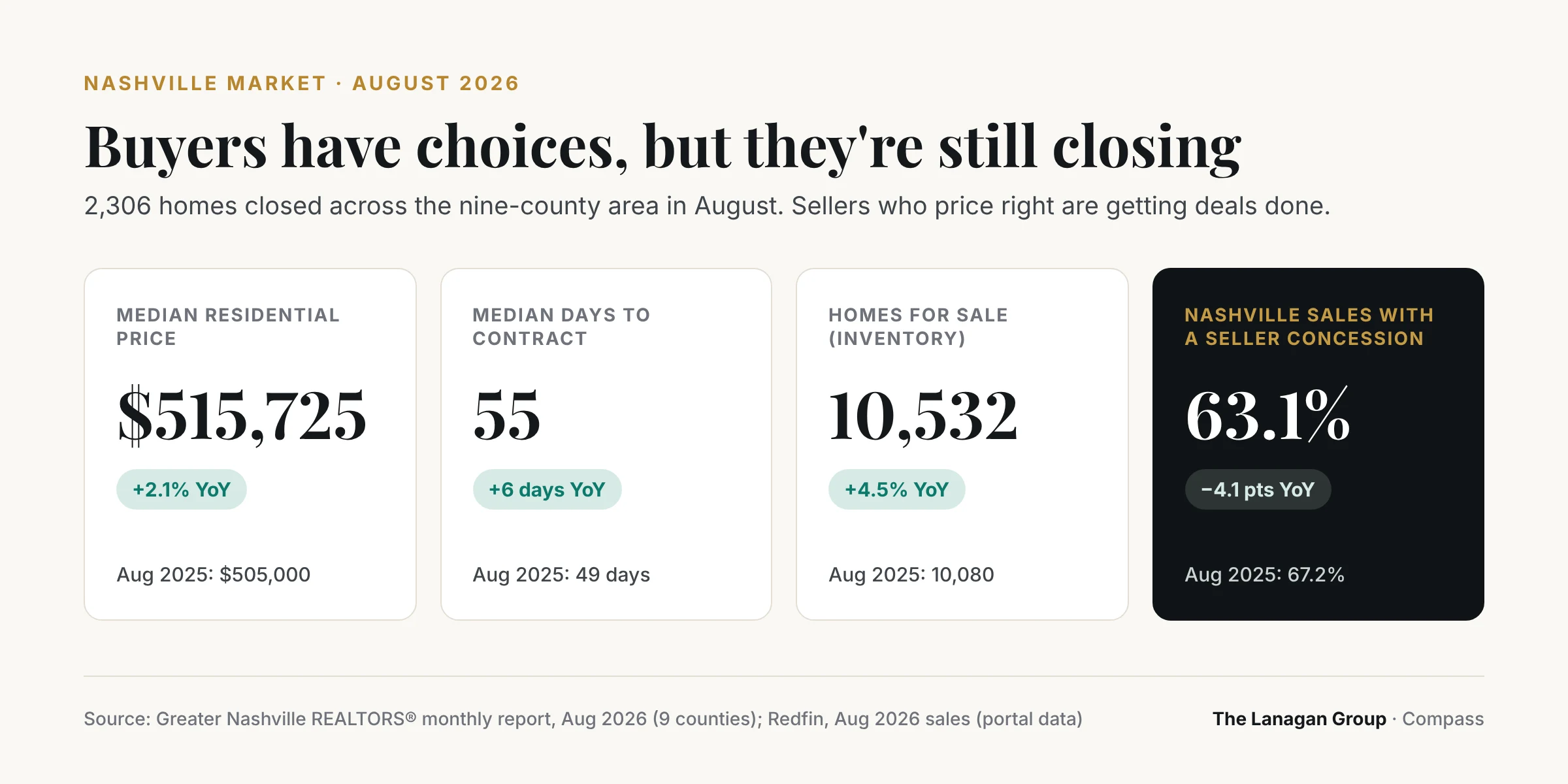
| Measure | August 2026 | August 2025 | Change |
|---|---|---|---|
| Median residential price (9 counties)1 | $515,725 | $505,000 | +2.1% |
| Median days to contract1 | 55 | 49 | +6 days |
| Inventory1 | 10,532 | 10,080 | +4.5% |
| Closings1 | 2,306 | 2,434 | −5.3% |
| Months of supply (10 counties)2 | 5.59 | 4.46 | +1.13 |
| Nashville sales with a seller concession3 | 63.1% | 67.2% | −4.1 pts |
1 Greater Nashville REALTORS® monthly report, August 2026 (nine counties). 2 RealTracs, August 2026 (10 counties). 3 Redfin, August 2026 sales (portal data); the 2025 value is derived from Redfin’s reported 4.1-point decline.
Two notes if you read our Oct. 1 buyer’s market post. First, that post described roughly 60% of Nashville sellers giving concessions; Redfin’s August figure is 63.1%. Second, it cited 36.5% of Nashville listings with a price drop. Redfin’s newer weekly measure, the share of active listings that cut their price during the four weeks ending Sept. 20, was 20.0% for Nashville, up 0.8 points from a year earlier and close to the 21.1% national rate. They measure different things, so both can be true.
Also notice what’s down: concessions dipped 4.1 points year over year and Nashville’s price-drop rate is in line with the nation. Sellers who price realistically at the start are getting deals done without chasing the market.
Why does the mortgage rate matter more than your list price?
Because buyers shop by monthly payment. The Mortgage News Daily 30-year fixed index was 7.57% on Oct. 2, 2026, up from 6.36% a year earlier. Freddie Mac’s weekly survey, which lags fast moves because it averages the week, showed 7.28% on Oct. 1. The 10-year Treasury yield, which mortgage rates follow, was about 5.28% on Oct. 5 (Trading Economics) after a weak September jobs report. That puts mortgages about 2.3 points above the 10-year, the same gap we noted in our Sept. 29 rate post.
On a $515,725 home with 10% down, a $464,153 loan at 7.57% costs about $3,268 a month in principal and interest (our calculation; taxes and insurance extra). A buyer who could comfortably handle that payment at 6.4% last year is now stretching. Your job as a seller is to close that gap, and there’s a cheaper way to do it than a big price cut.
Should you cut your price or pay for a rate buydown?
Run the numbers on the same $15,000 four different ways. All figures below are our own calculations for a $515,725 home, 10% down, 30-year fixed at 7.57%. They are illustrations, not lender quotes.
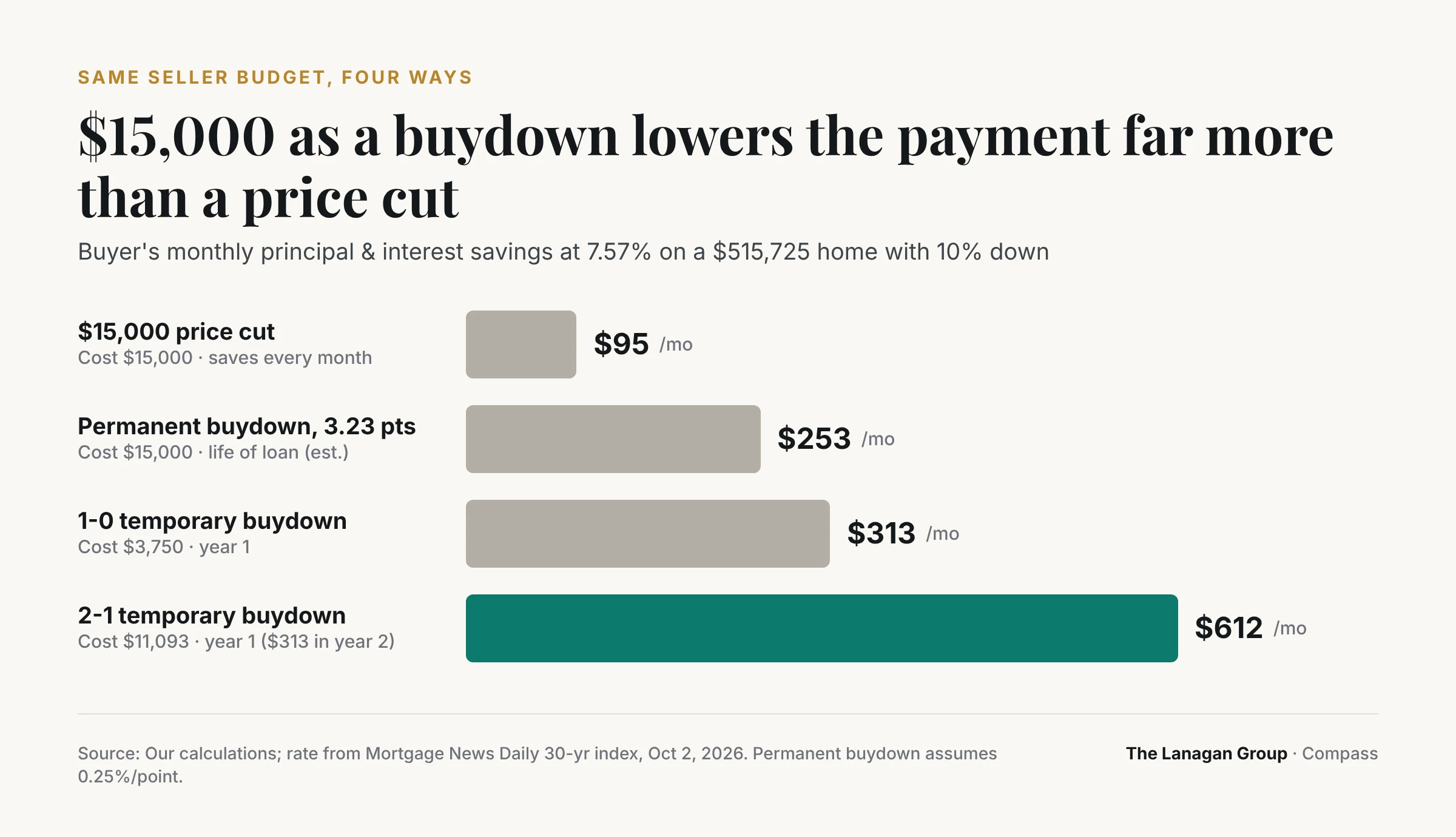
| Use of seller money | Seller cost | Buyer’s payment | Monthly savings |
|---|---|---|---|
| No concession | $0 | $3,268 | — |
| $15,000 price cut | $15,000 | $3,173 | $95, every month |
| 1-0 temporary buydown (6.57% year 1) | $3,750 | $2,955 in year 1 | $313 in year 1 |
| 2-1 temporary buydown (5.57% yr 1, 6.57% yr 2) | $11,093 | $2,656 / $2,955 | $612 / $313 |
| Permanent buydown, 3.23 points (~6.76%)* | $15,000 | $3,014 | about $253, every month |
Principal and interest only; our calculations. *Assumes each point (1% of the loan amount, per the CFPB) lowers the rate 0.25%. The CFPB notes the actual reduction depends on the lender, loan type and market, so get a written quote.
What does a 2-1 buydown cost a Nashville seller?
A temporary buydown is prepaid interest. The cost is simply the payment difference the buyer doesn’t pay, deposited up front. On our example, year one at 5.57% saves the buyer $611.87 a month and year two at 6.57% saves $312.54, for a total of $11,093. That leaves about $3,907 of a $15,000 budget for the buyer’s closing costs. Under Fannie Mae’s rules, temporary buydowns can last up to three years, the rate can step up no more than 1% a year, they’re for primary residences and second homes (not investment property), and the funds sit in a separate custodial account.
One important catch: Fannie Mae requires lenders to qualify the buyer at the full note rate, not the bought-down rate. A 2-1 buydown makes the first two years easier to live with. It doesn’t help a buyer who can’t qualify at 7.57%. For that buyer, a permanent buydown, which lowers the note rate itself, is the better tool.
How much can a seller contribute?
Fannie Mae calls these “interested party contributions” and caps them by down payment, calculated on the lower of the sales price or appraised value (Selling Guide B3-4.1-02). FHA, VA and jumbo loans follow their own rules, so confirm with the buyer’s lender.
| Occupancy | Loan-to-value | Max seller contribution | On a $515,725 sale |
|---|---|---|---|
| Primary home or second home | Over 90% (less than 10% down) | 3% | $15,472 |
| Primary home or second home | 75.01%–90% | 6% | $30,944 |
| Primary home or second home | 75% or less | 9% | $46,415 |
| Investment property | All | 2% | $10,314 |
Source: Fannie Mae Selling Guide B3-4.1-02 (05/07/2025). Dollar amounts are our calculations.
So when is a price cut the right call?
A price cut still makes sense when your home is simply priced above its competition. No buydown fixes a listing that buyers see as overpriced next to the house down the street. A lower price also lowers the buyer’s down payment (by $1,500 in our 10%-down example) and the Tennessee realty transfer tax, which is $0.37 per $100 of value under Tenn. Code Ann. § 67-4-409 (Tennessee Department of Revenue); who pays it is negotiable. My usual approach: get the price right first, then use concession money where it moves the payment most.
How should you price a Nashville home when buyers have leverage?
Price to the market that exists this month, not last spring’s. With 5.59 months of supply in the RealTracs 10-county area in August, up from 4.46 a year earlier, buyers comparison-shop and skip anything that looks high. One Redfin agent put it simply: “Pricing attracts attention. Overpricing creates hesitation” (Redfin, Sept. 2026).
Conditions also vary a lot by county. In August, Wilson County homes sold in a median 27 days, while Davidson County carried 6.89 months of supply, the loosest in the region (RealTracs, August 2026). Williamson County’s median sale price was $934,950. A Franklin listing and an East Nashville condo need different strategies, and that’s where a local pricing plan earns its keep. If you want a starting point, try our home value tool, then let’s walk the comps together.
What does a winning listing look like this fall?
Here’s the playbook I use with sellers right now. In a competitive market, a strong strategy before you list is everything.
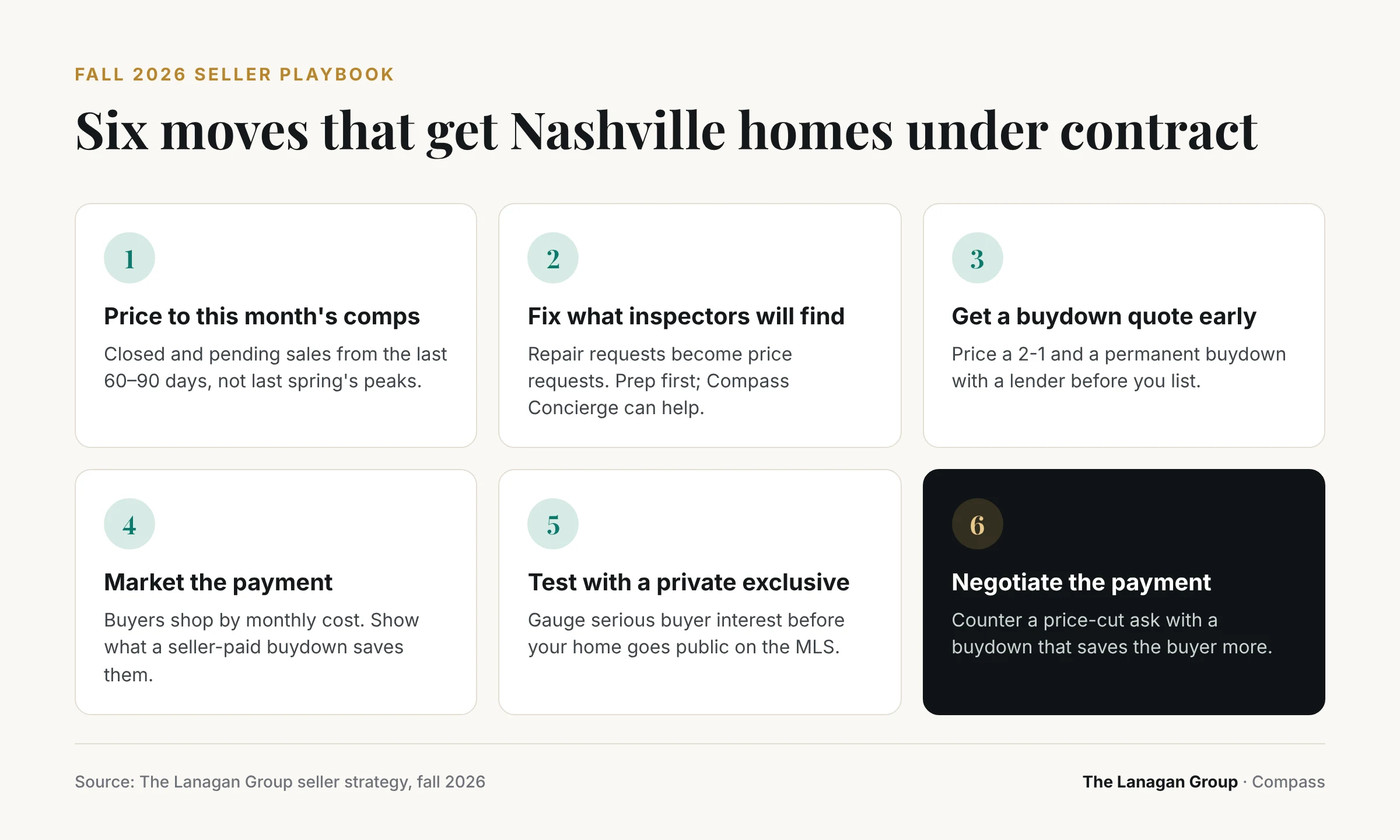
- Price to this month’s comps. Use closed and pending sales from the last 60–90 days, not old peaks, and watch active competition weekly.
- Prep and fix what inspectors will find. In a buyer’s market, repair requests become price requests. A pre-listing inspection and smart updates cost less than a renegotiation. Compass Concierge can front the cost of eligible improvements, repaid at closing.
- Get a buydown quote before you list. Ask a lender to price a 2-1 and a permanent buydown on your likely price so you know exactly what each costs.
- Market the payment. “Seller-paid 2-1 buydown: about $2,656 a month in year one” speaks to buyers who shop by payment. Your lender confirms the advertised figures and required disclosures.
- Test quietly with a private exclusive. Compass private exclusives let you gauge serious buyer interest and refine price before your home goes public on the MLS. Off-market access can give serious buyers an edge, and that buyer pool can work in your favor. See our off-market listings.
- Negotiate the payment. When an offer asks for a price cut, counter with a buydown that saves the buyer more each month and costs you less. Know your net before every counter.
What does a buydown look like over time?
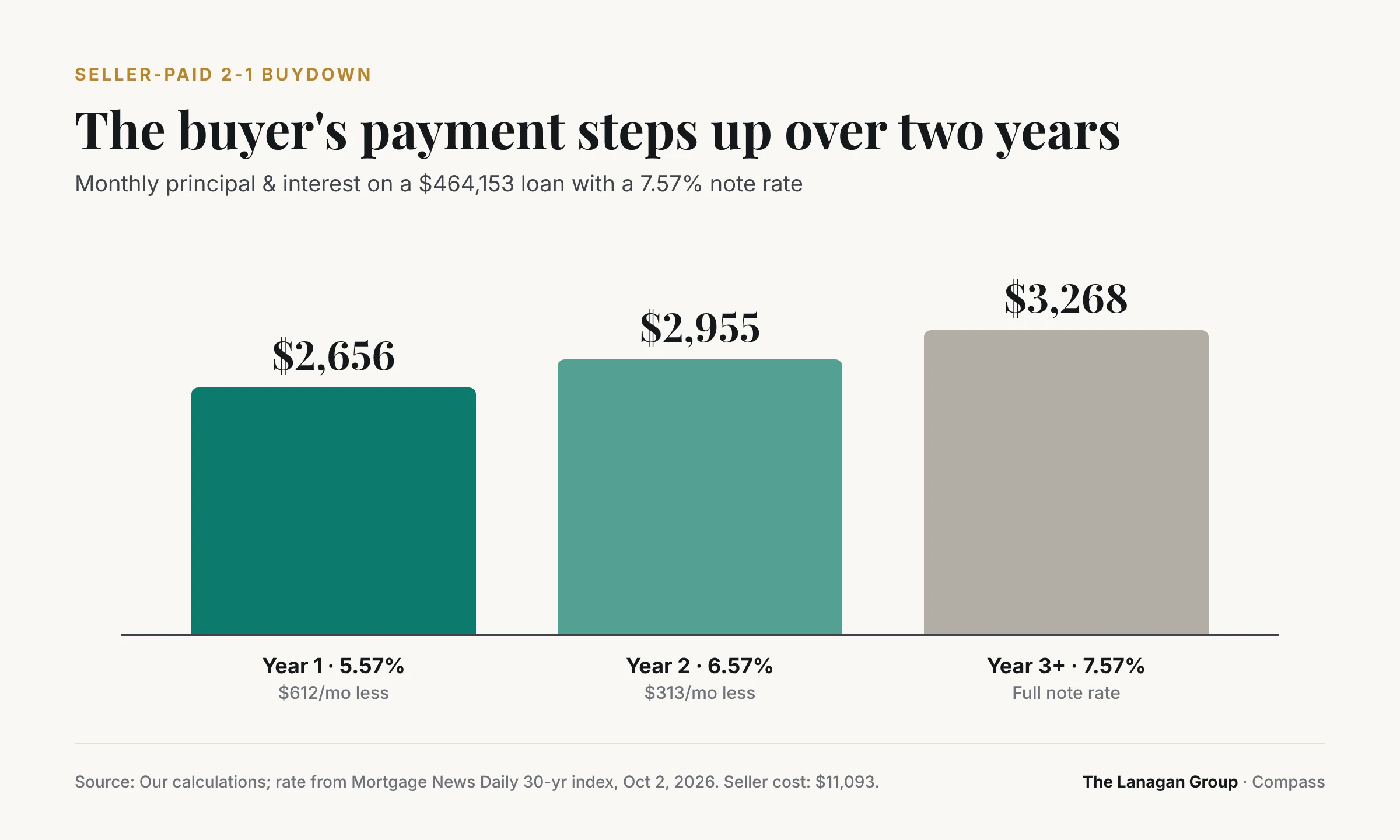
The appeal of a 2-1 buydown is front-loaded relief. In our example, the buyer pays about $2,656 a month in year one, $2,955 in year two and the full $3,268 from year three. If rates fall in the meantime, the buyer may be able to refinance; ask the lender how any unused buydown funds would be handled. Rates can rise as well as fall, so neither of us should count on a refinance.
Thinking about your full bottom line? Our guide to what sellers in Middle Tennessee actually pay at closing walks through transfer tax, title fees and prorations, so you can see how a concession fits into your net.
Ready to plan your sale?
Every seller I work with gets a pricing plan, a concession budget and a net sheet before we list, and the relationship doesn’t end at closing. If you’re weighing a move this fall or early next year, call or text me at 615-707-0321 or email ethan@thelanagangroup.com. You can also read what clients say on Google and Zillow.
Frequently Asked Questions
Is fall 2026 a good time to sell a house in Nashville?
It can be, if you price for current conditions. Greater Nashville REALTORS® reported 2,306 closings in August 2026, and RealTracs new contracts were up 1% from a year earlier. Buyers have more leverage, so sellers who price right and offer concessions that lower the monthly payment are the ones getting under contract.
What is a seller-paid 2-1 buydown?
It’s prepaid interest the seller funds at closing so the buyer’s rate is 2 points lower in year one and 1 point lower in year two, then returns to the note rate. On a $464,153 loan at 7.57%, it costs about $11,093 and saves the buyer about $612 a month in year one (our calculation). Buyers still qualify at the full note rate under Fannie Mae rules.
Is a rate buydown better than a price reduction for a seller?
Dollar for dollar, a buydown usually lowers the buyer’s monthly payment more. In our example, $15,000 as a price cut saves about $95 a month, while about $11,093 toward a 2-1 buydown saves $612 a month in year one. A price cut is still the right move if your home is overpriced against its competition.
How much can a seller pay toward a buyer’s closing costs in Tennessee?
Tennessee law doesn’t set the cap; the buyer’s loan program does. For a Fannie Mae conventional loan on a primary home, the limit is 3% with less than 10% down, 6% with 10% to 25% down, and 9% with more than 25% down; investment properties are capped at 2%. FHA, VA and jumbo loans have their own limits.
How long does it take to sell a house in Nashville right now?
The median was 55 days to contract in August 2026 across the Greater Nashville REALTORS® nine-county area, up from 49 days a year earlier. Timing varies by county; Wilson County’s median was 27 days in RealTracs data for August.
Should I wait for mortgage rates to drop before selling?
Nobody can promise when rates will fall, and the 10-year Treasury was still near 5.28% on Oct. 5, 2026. Waiting also means competing with more listings if inventory keeps rising. If you need or want to move, a seller-paid buydown lets you offer buyers lower payments now instead of hoping rates do it for you.
Let’s build your plan
The best sale starts with a strategy, not a sign in the yard. If you’d like a pricing review and a side-by-side of price cut versus buydown for your home, reach out here or visit our seller page. I’ll run the numbers for your address.
About Ethan Lanagan
Ethan Lanagan is the founder and CEO of The Lanagan Group at Compass, a REALTOR® serving Middle Tennessee and Southern California who specializes in sales, marketing, and consulting to help clients grow their investment portfolios and find their dream homes.
This article is general information only and does not constitute legal, tax, or financial advice. Confirm your specific numbers and requirements with your title company, tax advisor, or lender. Ethan Lanagan is a REALTOR® licensed in TN and CA, regulated by the Tennessee Real Estate Commission (TREC). The Lanagan Group is a real estate team affiliated with Compass RE, a licensed real estate broker. Equal Housing Opportunity.